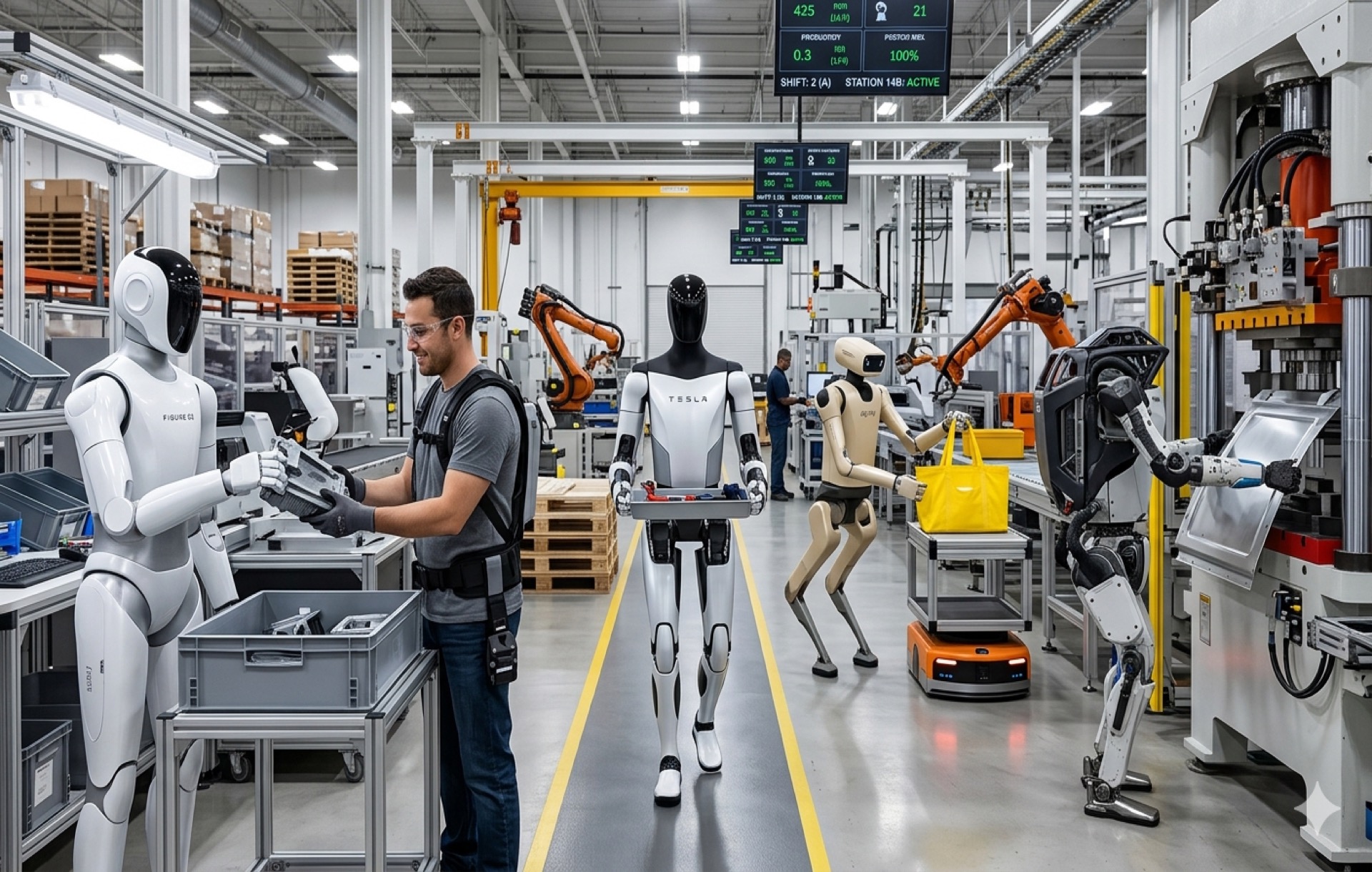
The year 2026 will be remembered as the moment humanoid robots stopped being a promise and became a product. Tesla shipped the 10,000th Optimus unit to a Gigafactory in January. Figure AI's Figure 02 is folding laundry, loading dishwashers, and stacking shelves in BMW plants across Germany. Agility Robotics' Digit is a fixture in Amazon fulfilment centres. China's Unitree and UBTECH have already undersold everyone at scale.
This is not a drill. The humanoid robot era has begun — and the choices you make right now, both professionally and financially, will compound for a decade.
The Numbers That Tell the Story
The market research is unambiguous about trajectory. The global humanoid robot market was valued at roughly $1.8 billion in 2024. By 2030, projections converge around $38 billion. That is a 21× expansion in six years — faster than the smartphone market grew in its first six years.
More telling than the market cap is unit economics. The cost to manufacture a general-purpose humanoid capable of 8-hour shifts in a structured environment has fallen from roughly $250,000 in 2022 to under $30,000 in mid-2026 for the leading Chinese producers. At that price point, robots become cost-competitive with minimum-wage labour for an enormous range of tasks — and the crossover point is still moving.
Three forces are driving the cost collapse simultaneously:
Actuator breakthroughs. The musculoskeletal design of a humanoid robot — motors, joints, tendons — accounts for roughly 60% of manufacturing cost. New solid-state actuators and compliant joint designs from startups like Apptronik and Electric Sheep have slashed both cost and failure rates.
Foundation models for embodied AI. The same transformer architecture that powers large language models turns out to work remarkably well for robot control policies. Models trained on billions of hours of video and simulation can now zero-shot generalise to tasks they have never seen in the physical world. The "dexterous manipulation problem" that stumped roboticists for decades was cracked not by mechanical engineering, but by scaling compute.
Vertical integration by deep-pocketed incumbents. Tesla's advantage in battery chemistry, motor design, and manufacturing automation gives Optimus a structural cost advantage that most competitors cannot replicate. Meanwhile, NVIDIA's Jetson Thor chip — purpose-built for humanoid inference — has become the de facto brain of choice, creating a platform layer not unlike iOS in smartphones.
Which Jobs Are Actually at Risk
The nuanced answer is: specific tasks within jobs are at risk, not whole occupations overnight. But some occupations are composed almost entirely of tasks that fall within the current capability envelope of 2026-generation robots. Those are the ones to watch.
High displacement risk (0–5 years)
- Warehouse picking and packing — already actively displaced; Amazon and Walmart have both announced multiyear robot-first hiring freezes for fulfilment roles
- Automotive and electronics assembly — structured, repetitive, well-lit; the ideal environment for early-generation robots
- Food production and packaging — higher than most people expect; the grip-and-place manipulation challenges were solved faster than predicted
- Basic retail stocking and inventory management — piloted in 150+ major retail chains across the US, Japan, and South Korea
Medium displacement risk (5–10 years)
- Commercial cleaning and facilities management — technically feasible now; adoption is slowing because of regulatory, insurance, and union friction rather than technology
- Construction trades involving repetitive tasks (rebar placement, drywalling, painting) — Boston Dynamics and Built Robotics have working systems; scaling logistics remain complex
- Agricultural harvesting for fruit and vegetable crops — the dexterity problem for delicate produce is largely solved; cost deployment remains the bottleneck
Lower displacement risk (likely safe through 2035)
Jobs requiring genuine interpersonal judgment, creative problem-solving in novel environments, or deep contextual adaptation remain highly resilient:
- Caregiving, nursing, and mental health support
- Complex project management and strategy
- Skilled trades requiring irregular environments (plumbing, electrical, HVAC in existing homes)
- High-stakes legal, medical, and financial advisory roles where accountability matters
- Creative direction, design, and any work requiring taste
- Teaching and coaching at anything beyond rote instruction
The pattern is consistent: robots are excellent at doing defined things in structured spaces. Humans remain essential wherever the definition is fuzzy and the space is uncontrolled.
How to Future-Proof Your Career
Invest in dexterity of a different kind. The most robustly human capability in 2026 is not physical but cognitive and relational: the ability to navigate ambiguity, build trust with other humans, synthesise incomplete information, and make judgment calls that carry moral weight. Develop these deliberately.
Learn to work with robots, not against them. Robot operations technicians, AI trainers, and automation integration specialists are already among the fastest-growing roles. A warehouse worker who understands how to calibrate, maintain, and troubleshoot robots earns 40% more than one who does not, according to a 2026 Brookings Institution report. The workers who adapt earn a premium; the ones who do not are squeezed.
Move up the value chain in your current field. If your role involves a significant portion of repetitive, structured task work, the question to ask is: what is the highest-judgment, most human-intensive version of what I do? That is the role to grow into. A logistics manager who deeply understands robot fleet optimisation is far more valuable than one who does not — and far more valuable than the robots themselves.
Build portfolio careers. Income diversification is no longer just financial advice — it is career risk management. Developing multiple income streams, skills, and professional identities insulates against the displacement of any single role.
The Investment Landscape
For investors, the humanoid robot wave creates opportunities at multiple layers of the stack — but not all of them are equally attractive right now.
Layer 1: Robot Manufacturers
The obvious play, but also the most crowded and most speculative. Tesla (TSLA) is the largest liquid exposure to humanoid robots, with Optimus now a meaningful line item in investor discussions. The challenge: Tesla's valuation already prices in significant robotics upside, meaning you are paying for optionality that may take years to deliver earnings.
Pure-play humanoid startups — Figure AI, Apptronik, Agility Robotics — are mostly private. Access is limited to accredited investors through vehicles like ARK Venture Fund or via secondary markets like Hiive and Forge.
Chinese robotics companies listed in Hong Kong (UBTECH Robotics: 9880.HK; Fourier Intelligence) offer cheaper valuation multiples, but come with geopolitical risk, regulatory uncertainty, and corporate governance questions that Western institutional investors are increasingly pricing in.
Verdict: Selective and position-sized. Full-position conviction requires believing a specific company wins the platform war — a high-uncertainty bet at this stage.
Layer 2: Enablers and Infrastructure
This is often where the better risk-adjusted returns are in platform transitions. During the gold rush, pick-and-axe sellers outperformed prospectors.
- NVIDIA (NVDA) — The Jetson Thor and Isaac simulation platform make NVIDIA the de facto AI brain supplier for the entire robotics industry, regardless of which robot manufacturer wins. Revenue from robotics is not yet a large portion of total, but design wins in 2026 models will compound into revenue by 2028–2030.
- Harmonic Drive SE (6324.T) — The dominant supplier of precision strain-wave gearing used in almost every humanoid robot joint. A boring industrial company with pricing power in a critical component — exactly the kind of business that holds up when robot manufacturers consolidate.
- Cognex (CGNX) — Machine vision systems are the robot's eyes. Cognex is the market leader and has been the quiet infrastructure play in industrial automation for 30 years. Robots needing to perceive and manipulate in unstructured environments need more vision, not less.
- Zebra Technologies (ZBRA) — Enterprise automation software and workflow management; already integrating robot fleet management into existing enterprise systems.
Layer 3: Beneficiary Industries
Companies that deploy robots rather than make them will see structural cost advantages accrue over time. The pure play here is logistics and manufacturing.
- Amazon (AMZN) — Already the largest private deployer of robots in the world; humanoid expansion reduces its structural cost of fulfilment at scale
- Foxconn Technology Group (2317.TW) — The world's largest electronics contract manufacturer, with 800,000+ employees in labour-intensive assembly; Foxconn has publicly committed to replacing 30% of headcount with robots by 2028
- Danaher (DHR) — Diversified industrial; significant exposure to automated laboratory and pharmaceutical manufacturing, both early adopters
What to Avoid
Robot ETFs with heavy dead weight. Several ETFs marketed as "robotics" or "AI" funds hold large positions in legacy industrial conglomerates with minimal humanoid robot exposure. Read the holdings before buying the narrative.
Purely speculative small-caps on revenue multiples. When a company with $12 million in revenue trades at 400× sales because it has "robot" in its name, the story is the product — and stories eventually meet earnings. The robotics hype cycle of 2025–2026 has created a number of these situations.
The Bigger Picture: Productivity, Inequality, and What Comes Next
The macroeconomic implications of humanoid robots operating at scale are profound and genuinely difficult to predict. The optimistic scenario: labour-augmenting automation, similar to what happened with personal computers in the 1990s, where technology raised productivity enough that displaced workers found better-paying roles as the economy expanded. The pessimistic scenario: labour-displacing automation that concentrates returns among capital owners and a narrower slice of highly skilled workers, widening inequality while depressing wages at the median.
History suggests the outcome depends less on the technology and more on how societies choose to manage the transition — through education policy, tax policy, and safety net design. The countries and companies that invest in upskilling their workforces and share productivity gains broadly will navigate the transition better than those that treat it as purely an efficiency exercise.
For individuals, the honest message is this: the humanoid robot wave is real, it is accelerating, and it will affect your career and your savings. Ignoring it is a strategy, but not a good one. Understanding it — the technologies, the timelines, the winners, the losers — is what separates people who thrive in this transition from those who are blindsided by it.
The machines are not coming. They are here. The only question is what you do with that knowledge.
This article is for informational purposes only and does not constitute financial advice. Investing in robotics stocks or any other securities involves risk, including the possible loss of principal. Always conduct your own research or consult a qualified financial advisor before making investment decisions.