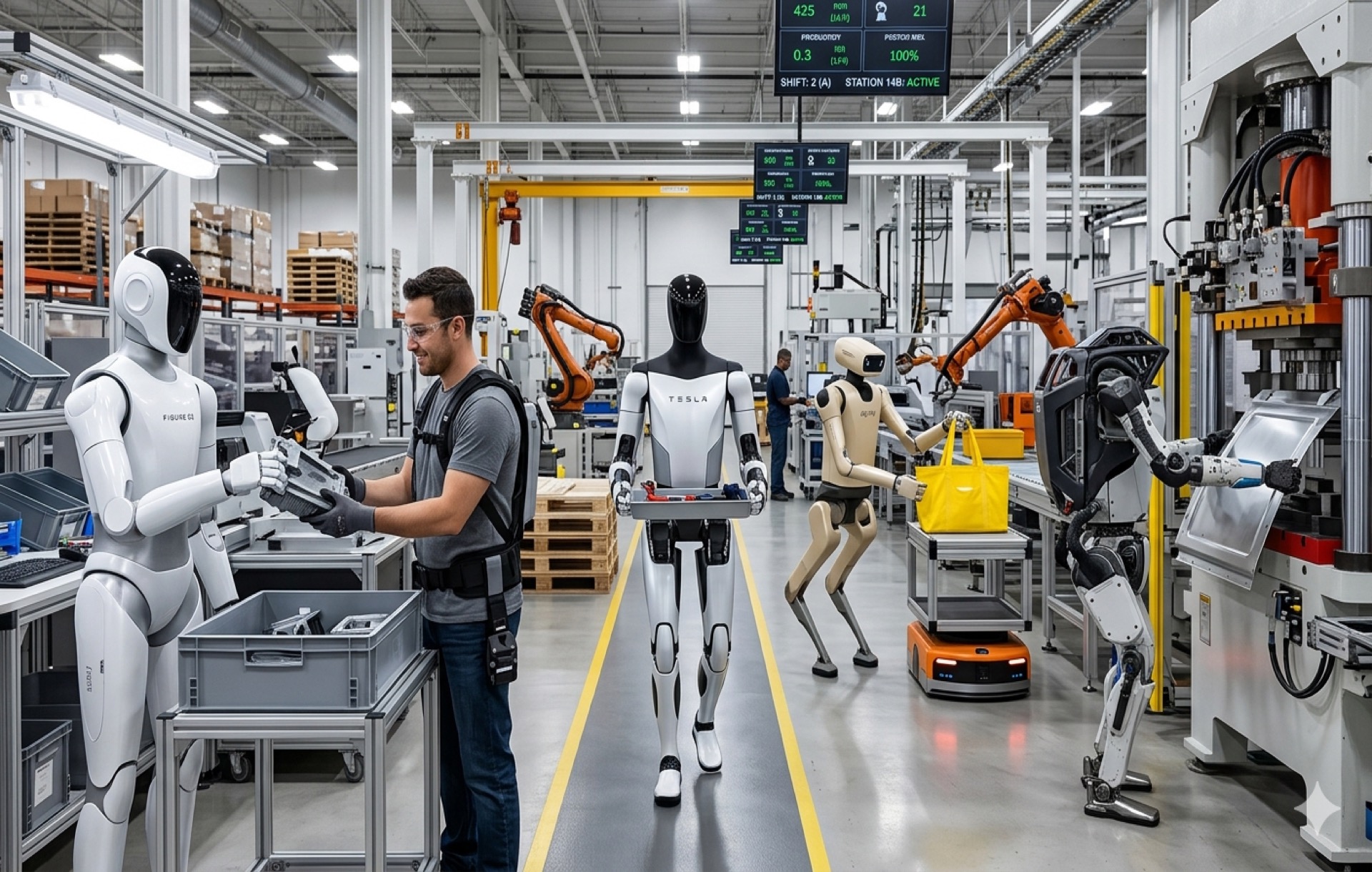
For decades, humanoid robots lived exclusively in two places: science fiction films and university robotics labs. The gap between what Hollywood imagined and what engineers could actually build was vast — decades of incremental progress that always seemed to leave the truly useful machine just around the corner. That corner has now been turned. In 2025 and 2026, humanoid robots crossed from controlled demonstrations into real commercial deployments, and the implications for work, daily life, and capital allocation are more immediate than most people yet appreciate.
This is not hype dressed up as analysis. The machines shipping today are imperfect, expensive, and narrow in capability relative to what will exist in five years. But imperfect machines shipping at scale marks a genuine inflection point — and understanding that inflection now, rather than after it is priced in everywhere, is where the opportunity lies.
From Boston Dynamics to a Competitive Market
The history of humanoid robotics is longer than most people remember. Honda's ASIMO debuted in 2000, walking up stairs and pouring drinks at press events while offering essentially zero commercial utility. Boston Dynamics spent years building progressively impressive machines — the backflipping Atlas, the agile Spot quadruped — while burning through capital at a rate that suggested the business model was demonstrations, not deployments.
The break came from an unlikely direction. The convergence of three independent technology curves — foundation model AI that can process vision and generate motor commands, improved actuators and battery energy density, and dramatically falling compute costs — compressed what would have been another decade of incremental progress into a few years of rapid capability gains. By 2024, multiple credible companies had humanoid robots capable of completing real manipulation tasks in unstructured environments. By 2025, some of those robots were on factory floors doing paid work.
The competitive field in 2026 is genuinely crowded:
- Figure AI — the San Francisco startup that secured significant investment from major tech companies and automakers. Its Figure 02 model is deployed in BMW and other automotive manufacturing facilities, completing tasks including parts handling and quality inspection.
- Tesla Optimus — the most high-profile entry, now in its third generation. Tesla has deployed thousands of Optimus units across its own manufacturing facilities and is in early-stage discussions with external customers. CEO Elon Musk continues to project extremely aggressive volume targets; the reality is more measured but still impressive.
- 1X Technologies (formerly Halodi Robotics) — the Norwegian company backed by OpenAI, taking a slower and more deliberate path focused on home assistance use cases. Its NEO robot is in early residential deployments.
- Agility Robotics (Amazon-owned) — Digit, the bipedal robot optimised for warehouse logistics, has moved from pilot to multi-site deployment in Amazon fulfilment centres across the US.
- Unitree — the Chinese manufacturer disrupting the market with aggressive pricing. Its G1 humanoid is available at a price point well below Western competitors, raising both commercial and geopolitical questions about supply chain concentration.
- Boston Dynamics Atlas (electric) — having retired the hydraulic Atlas in dramatic fashion, Boston Dynamics launched an all-electric version in 2024. Early commercial deployments began in 2025 in industrial and warehouse settings.
The market structure is evolving fast. Hardware margins are thin, which is pushing most serious players toward a robotics-as-a-service (RaaS) model — deploying robots to customers and charging per hour of uptime rather than selling units outright. This lowers the adoption barrier for businesses, creates predictable recurring revenue for manufacturers, and shifts the value proposition increasingly toward the software and AI layer rather than the hardware.
What the Machines Can Actually Do Today
Honest assessment of current capability matters enormously for both investors and workers making decisions about the near term.
Current genuine strengths:
Humanoid robots in 2026 are genuinely capable in structured industrial and logistics environments. They can:
- Pick, sort, and pack objects across a wide range of shapes and sizes, using vision systems and force-sensing hands
- Navigate dynamic environments with other workers and forklifts, detecting and responding to obstacles in real time
- Perform repetitive assembly tasks — bolt-driving, component insertion, surface inspection — with accuracy that meets manufacturing tolerances
- Work continuous shifts without fatigue, breaks, or the ergonomic injuries that plague human workers in physically demanding roles
- Operate in environments hostile to humans: extreme temperatures, high noise, chemical exposure, confined spaces
Current genuine limitations:
- Dexterity on unfamiliar objects remains a meaningful challenge. Robots handle well-defined objects reliably; novel or irregular items in unexpected orientations still cause failures.
- Speed in manipulation tasks is typically slower than a skilled human worker. The robot advantage is consistency and endurance, not pace — at least for now.
- Setup and retraining costs for new tasks are falling rapidly but remain non-trivial. Deploying a robot to a new task in a new environment requires significant engineering work.
- Cost — commercial humanoid robots still carry price tags in the range of $30,000–$100,000+ depending on the platform, with additional deployment and maintenance costs. The economics are compelling for high-value, high-repetition industrial tasks; less so for general commercial applications.
- Home environments remain genuinely difficult. The cluttered, unpredictable, socially complex environment of a human home is much harder than a controlled factory floor. Home assistant robots exist but are in narrow early deployments.
The Industries Disrupted First
Not all sectors will feel the impact simultaneously. The first wave is already visible.
Automotive Manufacturing
The auto industry sits at the intersection of the two things humanoid robots currently do well: precise, repetitive manipulation tasks and unpleasant working conditions. Assembly lines involve thousands of repetitive cycles, significant ergonomic hazard for human workers, and processes disciplined enough that robot integration is tractable. Multiple automakers — BMW, Mercedes-Benz, Hyundai (which owns Boston Dynamics) — are in active deployment or advanced pilot phases.
Logistics and Warehousing
E-commerce growth has created persistent labour shortages at fulfilment centres, particularly for the less glamorous picking and packing operations. Agility's Digit, Amazon's own robotics investments, and multiple competitors are targeting this sector. The economics are particularly favourable because warehouses are designed environments that can be modified to accommodate robots, and the labour costs are well-defined enough to calculate clear payback periods.
Electronics and Semiconductor Manufacturing
Precision electronics assembly has historically required human workers for fine motor tasks that traditional industrial robots could not perform. Humanoid robots with high-precision hands are beginning to displace humans here — a development with significant implications for the economics of manufacturing consumer electronics.
Healthcare Support
A growing deployment area is healthcare — not clinical care, which involves too much complexity and liability, but support roles: patient transport within facilities, linen and supply logistics, medication delivery within hospitals, and — in early trials — physical assistance for mobility-impaired patients with structured needs. This sector moves slowly due to regulatory requirements, but the demographic pressure of ageing populations makes it a compelling long-term target.
Agriculture
Field agriculture is physically demanding, cyclically intense (harvest season creates acute labour shortages), and performed in relatively structured repetitive patterns — a profile that suits current robot capabilities better than it might appear. Several companies are deploying humanoid and non-humanoid robots for harvesting tasks in controlled environments (greenhouses, polytunnels) where the robot's operating conditions can be partially standardised.
The Labour Market Question
Any honest treatment of humanoid robotics must engage directly with the labour market implications, which are real, uneven, and politically charged.
The displacement reality: Roles characterised by physical repetition, predictable environments, and limited social interaction are at near-term risk of automation. Warehouse workers, assembly line operators, and workers in similar roles should consider this a genuine structural signal, not alarmism. The economic incentive for businesses is clear, and the technology is improving rapidly.
The augmentation reality: In many professional contexts, robots will be tools that make human workers more productive rather than replacements. A construction worker operating with robot assistance can handle materials that would require a team; a healthcare worker with a robot colleague handling logistics can focus entirely on patient care.
The job creation reality: Every industrial transition in history has involved job displacement and job creation — the net effect depends on policy choices, retraining infrastructure, and the pace of transition. The robotics industry itself is creating substantial demand for robot operators, maintenance technicians, deployment engineers, and AI training specialists. These jobs are not automatically accessible to workers displaced from assembly lines, which is the central policy challenge.
The pace reality: Deployment at scale takes longer than demonstrations suggest. Factory integrations are complex, labour contracts matter, regulatory frameworks are evolving, and the economics only pencil out at specific task types and scales. The transition will be gradual at the aggregate level, even as it is rapid in specific sectors and roles.
Investing in the Humanoid Moment
For investors, the humanoid robotics theme offers genuine opportunity alongside substantial uncertainty. Several frameworks help navigate it.
The Picks-and-Shovels Approach
The identity of the dominant humanoid robot platform five years from now is genuinely uncertain — a competitive market with multiple well-funded players. The more durable investment thesis may be in the enabling components and infrastructure that all platforms require.
Actuators and motors: The core mechanical components of humanoid robots — the motors and gear systems that drive movement — are produced by a relatively small number of specialised manufacturers. Demand for high-performance, lightweight actuators is compounding rapidly regardless of which robot OEM wins.
Semiconductor content: Humanoid robots are compute-dense, requiring chips for perception (vision processing), reasoning (AI inference), and real-time control. The GPU and specialised AI chip suppliers stand to benefit from every robot deployed.
Sensor systems: LiDAR, force sensing, depth cameras, and tactile sensors are essential components. Leaders in these categories are well-positioned as the number of deployed robots scales.
Software and AI platforms: The ability to train, deploy, and manage robot workforces at scale is increasingly a software problem. Companies building robot operating systems, simulation environments for training, and fleet management platforms are competing for the highest-margin layer of the value chain.
Direct Exposure
For those seeking more direct exposure to the theme:
Public companies with significant humanoid robot programmes include Tesla (Optimus), Hyundai (Boston Dynamics), and a growing number of publicly listed component suppliers and industrial automation companies. None of them are pure-play humanoid robot investments — the theme is embedded within much larger businesses.
Private markets host most of the pure-play companies — Figure AI, 1X Technologies, Agility (now owned by Amazon) — with access limited to institutional investors and qualified buyers via secondary markets.
ETFs focused on robotics and automation themes offer diversified exposure to the broader automation investment thesis, though these inevitably include a mixture of traditional industrial robotics (which has existed for decades) alongside humanoid-specific companies.
The Valuation Challenge
Realistic assessment requires acknowledging that this theme has attracted enormous investor enthusiasm, and valuations in parts of the space reflect optimistic assumptions about the pace of deployment. The technology is real; the question for investors is whether current prices already discount the eventual outcome. Careful attention to which companies have actual paying customers, unit economics at scale, and defensible technology differentiation will separate durable investments from speculative positions.
Life With Robots: The Closer Horizon
Beyond industry and investment, the more personal question is how humanoid robots will affect daily experience in the coming years.
In the near term, most people will encounter humanoid robots in commercial settings before they appear in homes. The logistics worker in an Amazon facility, the auto parts inspector on a manufacturing line, the hospital aide rolling supply carts between wards — these are the faces of the first deployment wave.
For home assistance, the trajectory is real but slower. The prize is compelling: an ageing global population with growing care needs, a persistent shortage of human caregivers, and households increasingly interested in labour assistance. 1X's NEO and several competitors are pursuing this market aggressively. The honest estimate in 2026 is that useful, reliable home assistant robots for general household tasks are still a few years from mainstream deployment — but the timeline has compressed substantially from where forecasters placed it three years ago.
The robots entering homes first are likely to tackle specific, constrained tasks: laundry folding, dishwasher loading and unloading, grocery unpacking. These seem mundane. They are not — freeing hours of repetitive domestic labour each week has real lifestyle implications, particularly for households managing care for children, elderly relatives, or both.
What the Shift Requires of Us
Navigating any major technological transition well requires distinguishing the signal from the noise, and humanoid robotics currently generates more noise than almost any technology category.
For workers in at-risk roles: The clearest signal is to develop skills that complement rather than compete with automation. Roles requiring social judgment, creative problem-solving, physical work in truly unpredictable environments, and supervision of automated systems are all growing in demand. Retraining resources are increasingly available; the question is whether the institutional infrastructure — employer investment, government programmes, accessible learning pathways — scales fast enough to match the pace of displacement.
For business leaders: The question is not whether to engage with this technology but how to evaluate it rigorously. Pilot deployments in controlled environments with clear metrics are the appropriate starting point. The organisations that build institutional experience with robot deployment in this early period will have a meaningful advantage as costs fall and capability improves.
For investors: Selectivity matters more than sector enthusiasm. The humanoid robotics market will not have a winner-takes-all outcome — the industrial landscape is too diverse for a single platform to dominate all deployment contexts. Exposure to the enabling technology stack, to companies with demonstrated real-world deployments (not just demonstrations), and to the software layer governing robot behaviour at scale is likely to prove more durable than chasing whatever narrative is hottest in any given quarter.
The Longer View
Humanoid robots will reshape the physical economy. That much is not speculative — the technology works, the economics are compelling in growing numbers of contexts, and the competitive forces driving deployment are powerful and accelerating.
The shape of that reshaping is not yet determined. It will be influenced by policy choices around worker transition support, regulatory frameworks governing robot safety and liability, geopolitical dynamics around supply chains and technology transfer, and the speed at which AI capability continues to advance the ceiling of what robots can do.
What is clear is that this transition is happening faster than previous robotics waves, in part because the AI revolution has removed the most fundamental bottleneck — the machine's inability to reason flexibly about its environment. The robots of 2026 are not programmed; they are trained. That distinction is what makes them general-purpose in a way that prior generations of automation were not.
Arriving early to that understanding — whether as an investor, a worker planning a career, a business leader evaluating operational strategy, or simply a person thinking about how daily life will evolve — carries more value than waiting for the moment to become undeniable. By then, the transitions will already be well underway.
This article is for informational and educational purposes only and does not constitute investment or career advice. Conduct your own research and consult qualified professionals before making significant financial or professional decisions.