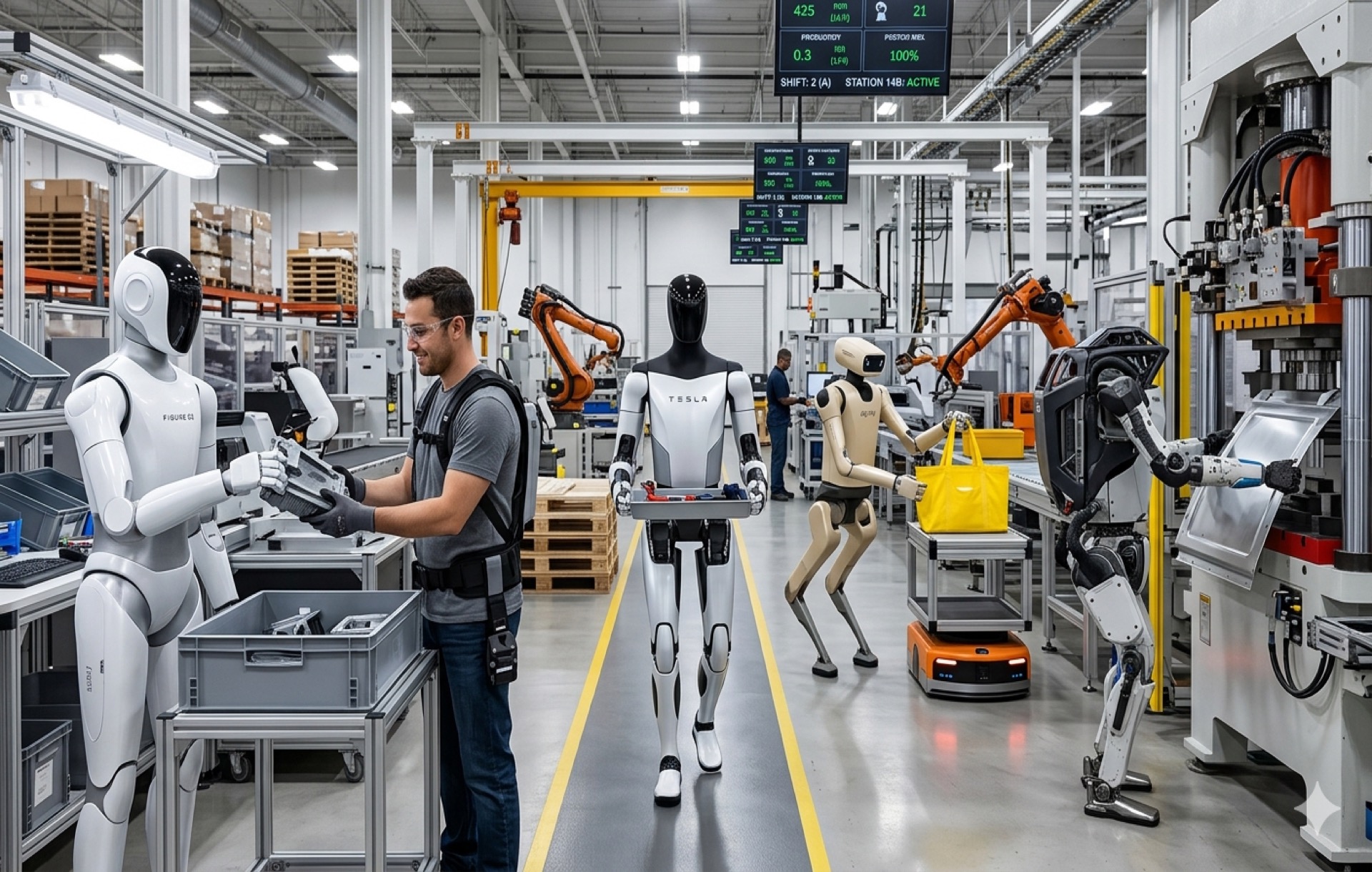
The Inflection Point Nobody Saw Coming
For fifty years, the humanoid robot existed primarily as a thought experiment. Engineers could build machines that welded, painted, and sorted with precision far exceeding human capability — but only within rigidly defined environments, performing exactly the tasks they were programmed to perform. The moment you asked a robot arm to pick up an unfamiliar object, navigate around an unexpected obstacle, or adapt to a task it hadn't been explicitly trained on, it failed.
That constraint has shattered — not gradually, but suddenly, in the way that major technological transitions tend to happen once the foundational pieces converge.
The combination of large language model reasoning, diffusion-based motion generation, massive robotic training data, and dramatically cheaper actuator hardware has produced a qualitative leap. Humanoid robots can now learn new manipulation tasks in hours rather than months. They can navigate unstructured environments. They can understand natural language instructions and translate them into physical action. And they are being deployed at scale in real production environments — not as prototypes, but as working machines measured against economic output.
The numbers are stark. Global humanoid robot deployments crossed 10,000 units in early 2026, up from fewer than 500 two years prior. Goldman Sachs revised its humanoid market forecast upward to $38 billion by 2030 after originally projecting a timeline a decade longer. Morgan Stanley estimates the addressable market could reach $150 billion by 2035 if key cost milestones are achieved. The race is no longer academic — it is commercial, competitive, and accelerating.
Why Humanoid Form Matters
The most obvious question is why robots need to be humanoid at all. Industrial robots — fixed-arm systems from FANUC, ABB, and Kuka — are extraordinary at specific tasks. Autonomous mobile robots like those from Locus and 6 River Systems move goods across warehouse floors with impressive efficiency. Why build something that looks like a person?
The answer is the world itself. Human civilization has been built around human bodies. Doorknobs, staircases, steering wheels, keyboards, hand tools — every physical interface assumes a five-fingered hand, a roughly 1.7-meter height, an upright gait. Specialized robots require specialized environments. A humanoid robot inherits decades of infrastructure investment.
This is the insight driving the entire field. A robot that can climb stairs, use a screwdriver, load a dishwasher, or operate industrial machinery designed for human workers does not require factories to be redesigned or homes to be retrofitted. It plugs into the existing world.
| Robot Type | Environment Required | Task Flexibility | Unit Economics (2026) |
|---|---|---|---|
| Industrial arms | Purpose-built cells | Narrow (programmed tasks) | $50K–$500K |
| Mobile warehouse robots | Flat surfaces, structured paths | Moderate (pick/navigate) | $30K–$100K |
| Humanoid robots | Any environment built for humans | High (general-purpose) | $50K–$150K |
| Human workers | Any | Highest | ~$50K/year in manufacturing |
The cost comparison is the crux of the economic argument. A humanoid robot priced at $100,000 with a ten-year operational life works three shifts with no benefits, sick days, or turnover. The labor cost equivalent over that period, in manufacturing contexts, ranges from $500,000 to $1.5 million per worker depending on geography. The math is challenging for labor markets — and compelling for manufacturers.
The Major Players: A Field That Has Compressed Decades
The competitive landscape for humanoid robots has consolidated rapidly around a small number of credible platforms, with meaningful differentiation in approach and target market.
Tesla Optimus: The Volume Play
Tesla's Optimus represents the most ambitious bet in the humanoid space — not on technical novelty, but on manufacturing at scale. Tesla's argument is straightforward: it has already solved the hardest parts of building intelligent machines that navigate the real world through Autopilot and Full Self-Driving. The same neural network training infrastructure, sensor fusion expertise, and large-scale manufacturing capability that produces 1.8 million cars per year can be redirected toward bipedal robots.
Tesla deployed several hundred Optimus units across its own factories in 2025, primarily performing parts sorting and battery cell inspection tasks. The 2026 program has expanded to external customers in automotive and electronics manufacturing. Elon Musk has publicly targeted production of one million units per year by 2030, a figure that most analysts consider aspirational but no longer dismissible.
What distinguishes Optimus is not the robot itself — several competitors match or exceed it on specific benchmarks — but Tesla's credibility as a hardware manufacturer at scale and its integration with the FSD inference stack.
Figure AI: The Enterprise Partnership Model
Figure AI secured what may be the most consequential partnership in robotics history when it announced a collaboration with BMW, OpenAI, and a $675 million funding round in early 2024. The Figure 02 robot, deployed in BMW's Spartanburg, South Carolina factory, became the first humanoid performing automotive assembly tasks in a commercial production environment.
The OpenAI partnership is the technical differentiator. Figure's robots run a multimodal AI system — developed jointly with OpenAI — that allows them to understand visual inputs, process natural language instructions, and reason about tasks at a level significantly ahead of pure motion-planning approaches. A Figure robot can be told in plain English to "move the blue components to the assembly station" and execute the instruction without bespoke programming.
Figure has also moved to Figure 02 with notable improvements: dexterous hands with 16 degrees of freedom, a 25 kg payload capacity, and a claimed 4-hour battery life. The company's strategy centers on logistics and manufacturing customers who can absorb the current price point.
Boston Dynamics Atlas: The Platform Pivot
Boston Dynamics, now owned by Hyundai, made a striking decision in 2024: it retired the iconic hydraulic Atlas — the acrobatic research platform whose backflips had garnered hundreds of millions of YouTube views — in favor of a fully electric commercial version. The new electric Atlas keeps the name but is purpose-built for manufacturing deployments, emphasizing reliability and operational duration over athletic spectacle.
The first commercial Atlas deployments began at Hyundai's manufacturing facilities. The robot brings 40 years of Boston Dynamics' research into perception, locomotion, and manipulation into a commercially supportable package. The key differentiator is Atlas's mobility: it handles rough terrain, unstable surfaces, and novel environments that constrain competitors.
Boston Dynamics has the deepest robotics research heritage of any player in the field — but also the most challenging commercial track record. The electric Atlas pivot suggests a genuine commitment to commercial viability over research prestige.
The Chinese Challengers: Unitree, UBTECH, and Beyond
What the West's robotics industry underestimates is the scale and pace of Chinese development. Unitree Robotics, the Hangzhou-based startup that already produced the most commercially successful quadruped robots in the world with its Go and B series, released the H1 and G1 humanoids at price points that shocked Western competitors.
The Unitree G1, a full-sized humanoid with impressive dexterity, launched in 2024 at $16,000 — roughly one-fifth the price of comparable Western systems. UBTECH's Walker S has been deployed in manufacturing by BYD and other Chinese manufacturers. Fourier Intelligence, Agility Robotics (acquired by Amazon), and a dozen other players are producing functional platforms at scale.
The Chinese ecosystem combines government support for strategic manufacturing automation, a domestic electronics supply chain that drives down actuator and sensor costs, and a competitive domestic market that accelerates iteration. Western competitors are treating this threat with the same urgency that the semiconductor industry applied to advanced chip manufacturing.
What Robots Are Actually Doing Today
The gap between demonstration and deployment has historically been the graveyard of robotics companies. What separates this generation from previous cycles is verified commercial deployment — robots running in production environments, measured against economic metrics, operated by customers rather than developers.
Automotive Manufacturing
Automotive assembly remains the initial beachhead for humanoid robots because it combines high labor costs, structured environments, repetitive manipulation tasks, and manufacturers with capital to fund pilot programs. BMW, Mercedes-Benz, Honda, and BYD all have active humanoid programs.
The tasks being automated in 2026 are not the most glamorous: parts retrieval from storage racks, component inspection, fastener tightening in constrained spaces, and moving parts between assembly stations. These represent the tasks that are difficult to automate with fixed industrial systems (due to variation in parts orientation and environment) but within reach of a dexterous bipedal robot with good perception.
The metrics that matter: BMW reports that Figure 02 deployments have achieved roughly 85% uptime in controlled conditions — below human worker availability but above the threshold for positive unit economics at current pricing. As software matures and hardware reliability improves, industry projections target 95%+ uptime within three years.
Logistics and Warehousing
Amazon's acquisition of Agility Robotics and its Digit humanoid signals the logistics industry's conviction that humanoid robots will eventually displace the patchwork of specialized automation currently filling warehouses. The use case is unloading shipping containers — a physically demanding, variable task that requires reaching into non-standardized containers and retrieving packages of varying shapes and weights.
Digit has been piloted at Amazon facilities in Seattle and Nashville, handling container unloading alongside human workers. The current limitation is cycle time: Digit processes items at roughly one-third the rate of an experienced human worker. But cycle time improves with software, while the human cost does not decrease.
Semiconductor and Electronics
Taiwan's electronics manufacturers — facing acute labor shortages and the extreme precision requirements of advanced chip packaging — have been aggressive early adopters. TSMC and Foxconn both have active humanoid programs, focusing on cleanroom material handling and the repetitive precision manipulation tasks that characterize electronics manufacturing.
These applications favor robots with exceptional dexterity and precision over raw speed, creating a different benchmark than automotive assembly.
The Technology Stack: What Makes This Generation Different
The capabilities gap between 2022-era humanoid demonstrations and current deployments is not primarily a hardware story. The hardware has improved — better actuators, longer batteries, more capable hands — but the step change is in the AI stack running on the robot.
Foundation Models for Physical Control
The emergence of robotics foundation models — large models trained on diverse robotic data that can be fine-tuned for specific tasks — has collapsed training timelines. Previous approaches required hundreds or thousands of hours of task-specific demonstration data. Current foundation models can learn new manipulation tasks from dozens of examples, with some demonstrations showing effective generalization from fewer than ten.
Google DeepMind's RT-2, Stanford's Pi Zero, and Physical Intelligence's foundation model represent different architectural approaches to the same problem: creating a general-purpose brain for physical control that learns efficiently and generalizes robustly. The competition between these approaches is intense and the progress is rapid.
Simulation-to-Reality Transfer
The data problem in robotics — the difficulty and expense of collecting real-world training data — is being addressed through massive simulation. GPU clusters running physics simulators can generate billions of robot-environment interactions at a fraction of the cost of physical data collection. The key challenge is closing the "sim-to-real gap": ensuring that skills learned in simulation transfer reliably to physical hardware.
Recent advances in differentiable physics simulation and domain randomization (deliberately varying simulated environments to produce robust real-world generalization) have made sim-to-real transfer increasingly reliable for manipulation and locomotion tasks.
Whole-Body Control
Humanoid locomotion and manipulation interact in ways that require coordinated control of the entire body. Reaching for an object at an awkward height requires leg positioning, torso lean, and arm extension to be orchestrated simultaneously. The emergence of whole-body control algorithms — treating the robot as a single coordinated system rather than isolated subsystems — has dramatically improved the fluidity and capability of humanoid motion.
Economic and Labor Market Implications
No technology with humanoid robots' trajectory can be discussed honestly without addressing its labor market implications. The analysis is more nuanced than either the "robots will take all jobs" panic or the "new jobs will emerge" reassurance suggests.
The manufacturing sector employs roughly 330 million people globally. The tasks most immediately automatable by humanoid robots — repetitive physical manipulation in structured environments — represent a significant fraction of those jobs. The transition timeline matters enormously: automation that happens over decades allows labor markets to adapt; automation that happens over years produces displacement faster than reabsorption.
| Timeline | Estimated Humanoid Units | Primary Sectors Affected | Labor Market Assessment |
|---|---|---|---|
| 2026 | 10,000–50,000 | Automotive, electronics (pilots) | Negligible displacement — pilots and early adoption |
| 2028 | 200,000–500,000 | Manufacturing, logistics | Measurable displacement in specific roles |
| 2030 | 1M–3M | Manufacturing, warehousing, some services | Significant sectoral disruption |
| 2035 | 10M+ | Broad manufacturing and logistics | Structural labor market transformation |
The sectors with the highest near-term exposure include automotive assembly, electronics manufacturing, food processing, and warehouse operations. The sectors with lower near-term exposure include anything requiring complex social interaction, unstructured environments, or high-dexterity fine motor tasks in variable settings — construction, healthcare (direct patient contact), and skilled trades.
The historical parallel that best fits is not factory automation of the 1970s and 80s — which affected specific industries — but the introduction of containerization in shipping, which transformed logistics at global scale over two decades. The adjustment was real and uneven, but the long-term productivity gains were substantial.
The Investment Angle: How to Build Exposure
For investors interested in the humanoid robot theme, the challenge is identifying durable value in a sector where the competitive dynamics are evolving rapidly and most leading companies remain private.
Direct Robotics Exposure
The most direct public market exposure comes through companies with established robotics businesses being expanded by humanoid programs:
Boston Dynamics (Hyundai): Embedded in Hyundai Motor Group (HYMTF), Boston Dynamics provides robotics exposure combined with automotive exposure. A pure-play is not currently available.
ABB and FANUC: Traditional industrial automation leaders are integrating AI capabilities into their portfolios. Not pure-play humanoid, but beneficiaries of the broader automation wave.
Nvidia: The company most aggressively positioning itself as the infrastructure layer for physical AI. Project GR00T — Nvidia's humanoid robot foundation model initiative — combined with Isaac Sim (simulation platform) and the Jetson computing hardware that runs in most humanoid robots positions Nvidia as the "picks and shovels" of the robotic revolution.
Enabling Technology Layers
The most accessible investment exposure may be in the enabling technology layers rather than robot manufacturers themselves:
| Layer | Key Players | Investment Vehicle |
|---|---|---|
| AI chips for inference | Nvidia, AMD, Qualcomm | Public equities |
| Actuators and motors | Maxon, Harmonic Drive | Specialized or private |
| Lidar / 3D sensing | Luminar, Ouster | Public equities |
| Simulation platforms | Nvidia (Isaac), Mujoco/DeepMind | Embedded in larger companies |
| Cloud robotics infrastructure | AWS Robomaker, Google Cloud Robotics | Embedded in cloud providers |
ETF options: Several thematic ETFs provide diversified robotics and automation exposure, including ROBO Global Robotics & Automation ETF (ROBO), Global X Robotics & AI ETF (BOTZ), and ARK Autonomous Technology & Robotics ETF (ARKQ). These provide broad exposure but include substantial non-humanoid automation content.
The Horizon: What 2030 Looks Like
Projecting five years in any technology is humbling given how wrong most predictions prove to be. But several developments appear structurally likely given current trajectories.
Price parity with annual labor costs: If current cost reduction curves hold, humanoid robots will reach the $20,000–$40,000 price range by 2028–2030. At that price point, the economic case for automation in manufacturing wages above $15/hour becomes unambiguous. This is the threshold that changes deployment from strategic pilots to mass adoption.
Service sector entry: The transition from controlled manufacturing environments to service environments — retail, hospitality, elder care — requires significantly more robust general intelligence than current systems demonstrate. Progress here will lag manufacturing by three to five years, but the addressable labor market is orders of magnitude larger.
Human-robot collaboration as a workflow: The dominant near-term paradigm will not be human replacement but human-robot teaming — humans handling judgment-intensive, socially complex, and genuinely novel tasks while robots handle the physical, repetitive, and high-precision components. Factory floors already operating this way report productivity gains of 30-50% over human-only or robot-only configurations.
Regulatory frameworks: The rapid deployment of humanoid robots in commercial environments is running ahead of regulatory frameworks in most jurisdictions. Workplace safety standards, liability frameworks for robotic accidents, and labor market transition support policies are all areas where regulatory development will shape deployment pace and geography.
Key Takeaways
-
Humanoid robots are deployed commercially, not just demonstrated. BMW, Amazon, BYD, and others are running robots in production environments against economic metrics. This is categorically different from the previous decade's demonstration loops.
-
The AI stack is the real breakthrough. Foundation models for physical control, massive simulation training, and whole-body control algorithms have collapsed training timelines and enabled generalization that previous generations of robotics software could not achieve.
-
Chinese manufacturers represent an underestimated competitive factor. Unitree's $16,000 G1 and UBTECH's Walker deployments signal that the price-performance curve will compress faster than Western competitive analysis assumed.
-
The investment opportunity is real but requires selectivity. Direct exposure to leading humanoid companies remains largely private. The best public market positioning is through enabling technology layers — particularly Nvidia as the computational infrastructure of physical AI.
-
Labor market disruption is real and will be uneven. Manufacturing workers in automotive, electronics, and logistics face measurable displacement risk within five years. The timeline matters enormously for policy response.
-
The defining question is not whether humanoid robots will be transformative. That question is settled. The questions now are pace of deployment, which applications see adoption first, and how societies manage the transition from here to a world where physical AI is standard infrastructure.
The robots are no longer coming. They are here — imperfect, expensive, narrowly capable compared to where they will be in five years, but operating in real factories, processing real work, and improving at a rate that has surprised even their creators.
The decade from 2025 to 2035 will likely be looked back on as the period when physical AI crossed the threshold from demonstration to deployment — the decade that changed what machines can do in the world. Understanding that transition, even imperfectly, is more valuable than waiting for certainty that will arrive too late to act on.