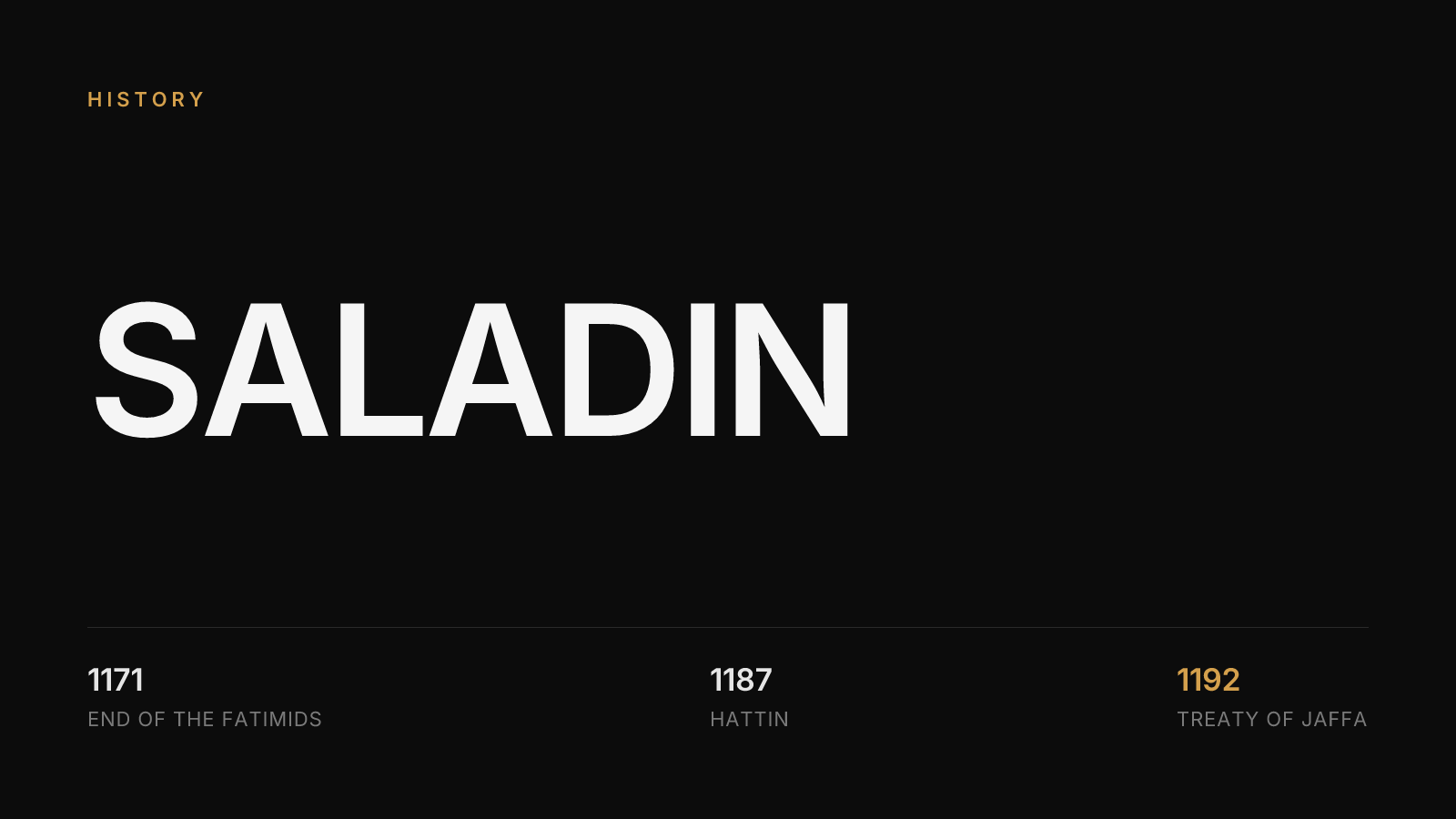
The One Enemy the West Chose to Admire
Saladin occupies an odd position in Western popular memory. He is close to the only medieval Muslim ruler most people in Europe or North America could name, and he is very nearly the only one they think well of. Two centuries of crusading handed the Western imagination a long roster of villains. It produced very few heroes on the other side, and only one with any real hold on the popular imagination.
That is a genuinely interesting fact, and it is not primarily about Saladin. It is about the people who wrote about him.
The reputation is not fabricated. He did something in 1187 that his enemies recorded, disliked, and could not explain away. But the finished portrait — the courteous adversary, the gentleman of the East, the man whose personal honour is the moral of every anecdote — was assembled in large part in Europe, by the heirs of the people he beat, across centuries in which the beating still needed explaining. A crusade that fails against a barbarian is a humiliation. A crusade that fails against a paragon is a tragedy. European writers had an obvious interest in the second version, and they produced it at length.
The overcorrection is just as wrong, and it is the more fashionable error now: that the chivalry was propaganda all the way down and the real man was an ordinary warlord with unusually good publicity. That does not survive the record either. He took Jerusalem without a general massacre at a moment when he had every military and political licence to conduct one, and the people best placed to report a massacre — Christian writers who despised him — record that there was not one. In the same year, he had prisoners taken at Hattin put to death.
Both of those things are in the evidence. Any account of Saladin that has to discard one of them to make the other work is not an account; it is an argument wearing one.
What follows tries to hold both, and to be explicit about which claims rest on dated events and which rest on writers who were either paid to admire the subject or needed to admire the enemy.
The Fracture He Was Born Into
To understand how a man in his position could end up ruling from Egypt to Syria, you have to start with how divided the region was.
The Latin kingdoms planted by the First Crusade had a security policy, and the policy was other people's arguments. A unified neighbour would have finished them, and they had never faced one. Egypt was governed by the Fatimid caliphate, which was Shi'a. The Sunni Abbasid caliphate claimed religious authority that Egypt did not recognise. Muslim Syria was a patchwork of rulers with local ambitions and long memories, the most formidable of whom was Nur ad-Din. The crusader states sat in the seam of that argument, and the seam is what kept them alive.
Into that world, around 1137, in Tikrit, Salah ad-Din Yusuf ibn Ayyub was born to a Kurdish family.
It is worth pausing on how unpromising that is. Legitimacy in the twelfth-century Middle East came from a short list of sources: descent, caliphal sanction, or command of an army somebody else had raised. He had the third at best, and only as a subordinate. He was not an Arab dynast and had no hereditary claim to anything. His family were professional soldiers in another man's service — the service, as it happened, of Nur ad-Din.
Nothing about that starting position predicts what happened. It does explain a great deal about what he did with power, because a ruler who cannot point to inherited right must manufacture legitimacy continuously, out of whatever material is available. In his case, the available material was religious orthodoxy and military success against Christians. That is not a cynical reading; it is what the position required, and it is visible in his career long before anyone in Europe had heard of him.
Egypt, and the Career Nobody Would Have Forecast
He entered Egypt as a subordinate, in an expedition led by his uncle Shirkuh on Nur ad-Din's behalf. That is the whole of his early prominence: he was a competent officer attached to a senior relative.
By 1169 he was vizier of Fatimid Egypt — the effective head of a government whose religious allegiance he did not share, serving a caliph whose legitimacy his own master rejected, while nominally answering to Nur ad-Din back in Syria. Three masters, no security — and he resolved it in his own favour within two years.
In 1171 he abolished the Fatimid caliphate outright. Egypt's allegiance was returned to the Sunni Abbasids. A Shi'a state that had governed Egypt since long before the crusaders arrived simply stopped, and the man who ended it was a Kurdish officer who had turned up as somebody's nephew.
This is where the Ayyubid dynasty begins, and it is worth being clear about the kind of achievement it was. Not a battlefield one. It was political demolition carried out from inside the building, and it converted Saladin from a delegate into a principal. It also bought him the thing his birth had denied him: standing with the Sunni religious establishment, which now had reason to call him a restorer rather than a usurper.
What followed is the part of his life that popular retellings compress into a sentence or skip altogether. When Nur ad-Din died, Saladin did not inherit Syria. He spent years taking it, and he took it from other Muslims. The campaigns, sieges and negotiations of that period were directed overwhelmingly at fellow Sunni rulers who had their own claims and no wish to be absorbed. Measured in years occupied, the dominant activity of Saladin's career was not fighting crusaders. It was consolidating Muslim Syria under his own authority.
The war with the Latin kingdoms ran alongside all of this, and it did not always go well. In 1177 he was beaten in open battle at Montgisard by a much smaller crusader force led by a sixteen-year-old king — Baldwin IV, the same war seen from the other side, and a useful corrective to any impression that his advance was smooth. But Montgisard cost him an army; it did not cost him Egypt, and Egypt could produce another. Ten years later the Kingdom of Jerusalem would find it had nothing equivalent to draw on.
Hattin, and the October That Followed
On 4 July 1187, at Hattin, Saladin destroyed the field army of the Kingdom of Jerusalem.
The military essentials are firm and require no embroidery. The crusader army marched, and in marching it left its water supply behind. In that terrain, in July, that is not a tactical error you recover from. It is the battle. Saladin let his opponents' worst option stay available, then closed on an army that was finished before the serious fighting started.
The consequence was not a defeat but an erasure. The kingdom had one field army, and the whole structure of crusader defence assumed that army was there. After Hattin it was not. The cities fell in sequence over the following months not because each was stormed but because no force existed that might come to relieve them.
Prisoners taken at Hattin were executed on Saladin's order. That belongs here, in the middle of the article, rather than in a footnote — it is the fact most often quietly relocated to the margins of the chivalric portrait. Popular accounts differ on who was executed, how many, and by whose hand; those details are less secure than the executions themselves. Take the general fact and leave the theatre alone. He was capable of killing captives when he judged it useful, and after Hattin he judged it useful.
Jerusalem surrendered in October 1187. It was not stormed; it was negotiated, and the terms involved ransom.
Here is the comparison everyone reaches for, and for once it holds. When the First Crusade took the city in 1099, the result was a sack and a slaughter. In 1187 there was no general massacre.
But the reason that contrast carries weight is not the contrast itself — it is who reports it. Restraint claimed by a ruler's own household historians would be worth very little. Restraint recorded by hostile Christian writers, people with every reason to describe an atrocity and no reason at all to invent clemency, is a different class of evidence. It is testimony against interest, and it is about the strongest evidence the twelfth century offers.
That deserves an honest reading of what a negotiated surrender with ransom actually is. A ransom system prices freedom. It does not distribute it. People who could pay left; people who could not were not simply released to go on with their lives, and what happened to them is exactly the sort of thing partisan sources on both sides had reasons to shade. What is well supported is the absence of a general massacre. "Merciful conqueror" is a larger claim, and it is a later one.
What the victory did not buy
Jerusalem's fall triggered the Third Crusade, and the Third Crusade is where the legend acquires its co-star.
Richard I arrived, won at Arsuf in 1191, and fought around Jaffa. Neither man broke the other. The campaign settled into a war in which neither side could be dislodged — one from the coast, the other from the interior. It ended in 1192 with the Treaty of Jaffa, which left Jerusalem in Saladin's hands and guaranteed Christian pilgrims access to it.
That is a negotiated draw, and it is the honest description of the end of Saladin's war: not a conquest completed, but a position held against the largest counter-effort Europe was able to organise.
He died in Damascus in 1193, the year after the treaty. The sources report that he left almost no personal fortune — that the man who had ruled Egypt and Syria had disposed of very nearly everything. It is among the most quoted details of his life, and it comes to us from writers who wanted it to be true. That does not make it false. It makes it a claim about a private matter, made by admirers, and it does not deserve the same confidence as the date of Hattin.
What the Sources Actually Support
The evidence for Saladin has a specific shape, and knowing the shape tells you which parts of the story to lean on.
The Arabic sources closest to him are the least neutral. The most valuable accounts of his life were written by men inside his own administration — Ibn Shaddad, who served him, is the best known of them. This is excellent evidence in one respect: they knew him, were present, and recorded specifics nobody outside the household could have supplied. It is compromised in another: they were writing about a patron, largely after his death, in a genre that expected admiration and rewarded the demonstration of it. When they describe his generosity, his piety, or his personal conduct, they are doing the thing they were there to do. That is not a reason to discard them, but it is a reason not to treat their character sketches as court records.
The European sources are unreliable in the opposite direction, which is precisely what makes some of them useful. Christian writers had no interest in flattering the man who had taken Jerusalem. So when hostile chroniclers confirm the restraint at the 1187 surrender, that confirmation is worth more than any amount of praise from his own secretaries. The rule does most of the work in this period: a fact reported by a writer who would rather it were not true is stronger than a fact reported by a writer whose job was to report it.
The chivalric Saladin is a later European construction, and it is a construction on top of a real foundation. The medieval and post-medieval European tradition elaborated him into an exemplar of knightly virtue — a figure whose courtesy is the point of the story and whose function is to be a worthy opponent. Those elaborations were written by the losing side, for the losing side's audience, and they grew freer with the facts the further they got from 1187. The foundation under them, though, is not nothing: the writers who started the process were reaching for an explanation of a real event, and the event was that a city changed hands without the bloodbath everyone expected.
So the enemy-testimony argument cuts both ways, and it is worth separating the two edges. The 1187 restraint is a specific, dated, checkable episode reported by people who disliked reporting it. The general chivalric character is a literary theme that served its authors' needs. These are not the same class of claim, and collapsing them is how the legend gets built.
The firm ground carries the whole article, so here it is plainly. He was born around 1137 in Tikrit, to a Kurdish family with no dynastic claim, and rose in Nur ad-Din's service. He entered Egypt under Shirkuh and was vizier of Fatimid Egypt by 1169. In 1171 he abolished the Fatimid caliphate, returned Egypt to Sunni Abbasid allegiance, and founded the Ayyubid dynasty. Years of consolidating Muslim Syria followed, much of it against other Muslim rulers, with a defeat at Montgisard in 1177 along the way. On 4 July 1187 he destroyed the Kingdom of Jerusalem's field army at Hattin, which had left its water behind, and had prisoners executed afterwards. Jerusalem came to him by negotiated surrender that October, without a general massacre. He fought Richard I to a standstill through Arsuf in 1191 and the Treaty of Jaffa in 1192, and died in Damascus in 1193.
The soft ground is the interior of the man: his motives, his piety as distinct from his performance of piety, his private conduct, and the exact arithmetic of who died at Hattin and who was enslaved after Jerusalem. The chivalrous sultan belongs on this ground too. He was not discovered in the evidence; he was built out of it, by writers on both sides who each had a use for him, and by the time he reached us the joins had stopped showing.
The figure the evidence does support needs no help. A Kurdish officer with no claim to anything dismantled a caliphate from inside its own government, spent most of his career subduing his co-religionists in order to be free to fight anyone else, destroyed a kingdom's field army in a single battle because its commanders had marched away from water, and then declined to do the obvious thing to its capital — which his enemies noticed, and wrote down, and never quite forgave him for.
His enemies wrote the version of him that survived. They were not being generous; they were explaining themselves.