The Ivar Everyone Knows Was Written Later
Most people arriving at this name have met him already. Vikings ran from 2013 to 2020 and gave Ivar a face, a disability with a modern clinical name, a father, brothers, a grievance, and a scene for each of them. It is a well-made show, and it is why anyone searches for him at all.
Almost none of that portrait can be checked against anything written near the ninth century. That much is the ordinary complaint about historical drama, and it is not what this article is about.
The interesting part is that the inventing did not begin with television. It began roughly three hundred years after Ivar, in another country and another language, far enough from the early material to be pulled apart from it. You can watch the story being assembled.
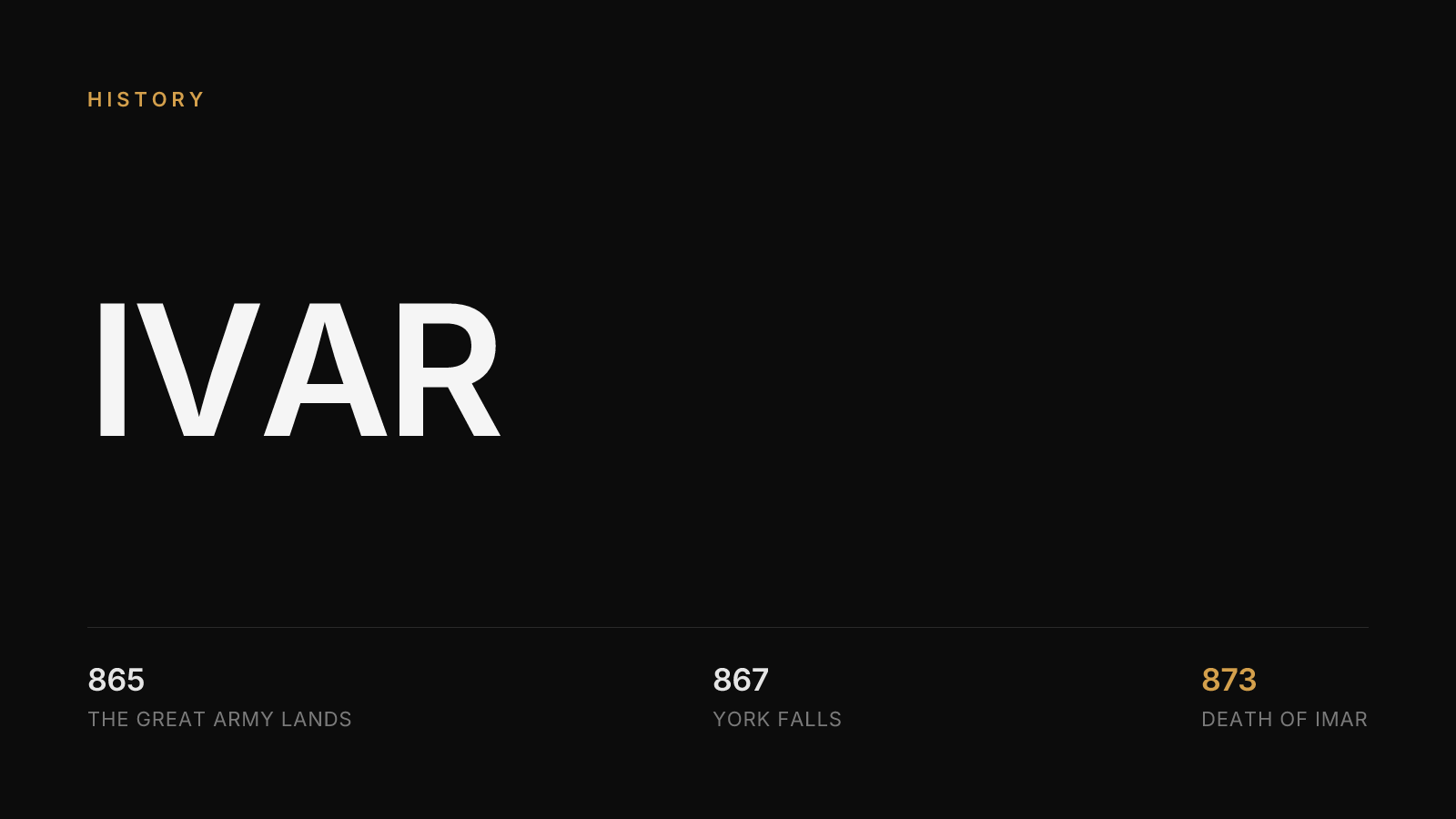
Here is the shape of the problem. The invasion Ivar is famous for is one of the better-recorded events of its century in England. A "great heathen army" — the phrase belongs to the Anglo-Saxon Chronicle — landed in East Anglia in 865. York fell in 867, and Ælla, king of Northumbria, died. Edmund, king of East Anglia, was killed in 869. Those are dated entries in a record kept in England, close in time to what it describes.
The commander is a different order of evidence. The parentage everybody knows — son of Ragnar Lothbrok, in England to avenge him — comes from Icelandic sagas written more than three centuries later, about a father whose own existence is doubtful. The byname has never been explained. The single most famous act attributed to him appears in no contemporary source at all.
So this is not a biography. It cannot be. It is an account of a thoroughly attested invasion, a barely attested man, and what filled the space between them.
The Difference Between a Raid and an Army
Ships had been coming for generations before 865, because the coast was worth the voyage. That is background. The story is that this time the ships did not go back.
Raiding is seasonal work. It takes what is portable and depends on being gone before anyone can assemble a response, which means the response never has to become permanent. An army that stays inverts the problem. It has to be fed through a winter, so it has to hold ground, and holding ground is the difference between a nuisance and a conquest.
No source is needed to establish that this is what happened; the dates do it alone. The army that landed in East Anglia in 865 was still in England two years later when York fell, and still there two years after that when the king of East Anglia was killed.
What made that viable was the shape of England, which was not a country. It was a set of separate kingdoms with separate kings and separate priorities — the two whose kings the record shows dying in these years are Northumbria and East Anglia — so an invader who intends to stay does not have to defeat England. He defeats them one at a time, and each decides for itself whether the war has arrived yet.
The Chronicle's adjective is also the only measurement anyone gets. "Great" says the force was larger than what the English were used to, which is comparative and useful, but it is not a headcount — every figure you have read for the size of the Great Heathen Army is a modern estimate rather than something a ninth-century writer put down.
Ímar, and What a Probable Identification Is Worth
This is normally where an article like this describes a rise to power. There is not one to describe. Nothing survives about how Ivar came to command anything, or whether he did, and manufacturing a career for him would be the exact error this piece is about.
What does survive is the name in a second place.
The Irish annals record a king named Ímar, based in Dublin, who died in 873. That is a separate body of material from the English Chronicle and from the sagas — another island, other compilers, no interest in Ragnar and no stake in England's troubles. Ímar is what the Norse name Ívarr looks like when an Irish annalist writes it, the chronology fits, and the Irish Sea and northern England belonged to one connected world in these decades rather than two sealed ones.
The identification is probable, and probable is the right word for it — not proven, and not the kind of thing the surviving material could prove. It is also frequently oversold. If it holds, Ivar stops being a purely literary figure: there is a man, in a real place, with a death date, recorded by people who had no stake in any of the stories later told about him. That is a valuable thing to have.
What it does not do is underwrite anything else. Ímar's attestation is attestation of Ímar. It says nothing about Ragnar, nothing about how Ælla died, and nothing about the nickname. A real man can acquire an entirely invented life story afterwards, and that is the common outcome rather than the rare one.
What the sagas add, and when they added it
The sagas supply the thing annals never do, which is motive. In them Ivar has a father, Ragnar Lothbrok, and a reason: Ragnar dies in Northumbria, and his sons come to England to settle it. It is a clean and satisfying structure, and every load-bearing element of it is late. This material was written down in Iceland in the thirteenth century, more than three hundred years after 865. Ragnar's own historicity is doubtful — the likeliest reading is that he is a composite, several ninth-century figures and a quantity of legend collapsed into one memorable name. Building Ivar's identity on being Ragnar's son means resting it on a foundation that may never have been a person.
Annals record movements. Sagas supply reasons. Reasons are the part that gets invented.
The byname nobody has explained
The Old Norse is inn beinlausi. "The Boneless." Nobody knows what it meant.
Four readings compete, and they have been competing for a long time.
Read literally, it is a marvel — a man without bones — and the literature that carries the byname is comfortable with marvels, so the reading is less absurd inside its genre than outside it.
Read medically, it points to a physical condition. Osteogenesis imperfecta, brittle bone disease, is the popular modern candidate and the one the television series adopted. It is a guess — a retrospective diagnosis built from a nickname in a source centuries removed from the man, with no description of symptoms, no course of illness and no body. Set beside that, most retrospective diagnoses in medieval history are luxuriously well evidenced.
Read as an insult, it concerns impotence, which is the sort of thing bynames in this culture were frequently for. They were not all descriptive and they were not all kind.
Read as a textual problem, it is a corruption — a garbling of some other word — in which case the debate is about a scribe's slip and there is nothing underneath it at all.
No evidence decides between these. The most famous single fact about Ivar the Boneless is his name, and the name has never been understood.
865 to 869: The Part That Is Documented
The campaign, stated at the level the sources support, is short.
In 865 an army landed in East Anglia. In 867 York fell and Ælla, king of Northumbria, died. In 869 Edmund, king of East Anglia, was killed. Two kingdoms lost their kings within four years of the landing, and the force responsible was still in the country.
York carries more weight than the bare sentence suggests. It was the principal city of Northumbria, and taking it is not a raid on a river town. It is the capture of a kingdom's centre, which is what an army does when it intends to keep what it takes.
That is the documented campaign. Notice what is in it and what is not. The sequence, the dates, the outcomes — a city taken, two kings dead. The manner of the deaths is not there, and the manner of the deaths is the entire reason most people know these names.
The blood eagle
This is what most readers arrive already believing, so here it is in full.
Norse literature contains descriptions of a killing in which the victim's back is opened and the ribs drawn outward to resemble a pair of wings. The tradition attaches it to Ælla, and gives it a purpose: Ivar's revenge on the king said to have killed his father.
Every element of that comes from the same late layer. The rite appears in literary material, not in annals. It arrives with Ragnar attached, and Ragnar is doubtful. It is absent from the contemporary English record, which reports that Ælla died in the year York fell and says nothing about how.
Historians treat this the way they do for reasons that have nothing to do with squeamishness. No source written anywhere near 867 mentions the rite. The detailed accounts are literary, produced by a tradition whose business was heroic narrative rather than record-keeping. And there is a long-running argument that the whole thing is a literalisation — that ambiguous poetic imagery about eagles and the backs of the slain, which is ordinary battlefield metaphor, was later read as the description of a procedure and written up as one.
That argument may be wrong. Absence of contemporary record is not proof that something did not happen, and the ninth century failed to record most of what it did. But there is a wide gap between "this cannot be ruled out" and "Ivar did this to Ælla," and it is the second sentence that gets repeated.
The same problem, in a milder form, governs Edmund. That he was killed in 869 is contemporary. The elaborate accounts of how he died are later, and they answer to a tradition with its own requirements: Edmund became a saint, and a martyrdom has a shape it is expected to fill.
After 869 the record stops being about Ivar in any usable way. If the Dublin identification holds, the man died in 873, four years after Edmund, and the annals that record it are Irish.
What the Sources Actually Support
Sort the evidence by how far it stands from 865 and a pattern appears immediately.
Closest are the English annals. The Anglo-Saxon Chronicle is a year-by-year record kept in England in the vernacular, and for the 860s it is near-contemporary — written by people for whom this was recent, in the country where it happened. It has obvious commitments; it is English, Christian, and writing about people it regarded as enemies. But those commitments are easy to see, and its concern in these entries is that the events happened rather than why.
Alongside them, and independent of them, sit the Irish annals. Their value comes from being unconnected: they are not participating in the English story, and they had never heard of the sagas, which had not been written. Ímar's death in 873 is therefore a separate witness, and separate witnesses are the scarcest commodity in ninth-century history.
Then, three centuries out, the Icelandic material. This is where Ivar acquires everything that makes him memorable: the father, the brothers, the vengeance, the rite, the mythology around the nickname. It is a serious literature and it is not exactly lying — it is doing something other than reporting. Its purpose was to give a remembered heroic past a shape, and shape means causes and consequences arranged into a story that works.
Now line up the claims against that ordering. The duller a claim is, the better attested it is. An army landed. A city fell. A king died. A king in Dublin died. Every one of those is early and unexciting. The father, the revenge, the rite, the strange body — the entire memorable half — comes from the far end. That is not bad luck in what survived. It is what the far end was for.
The opposite error is also available. Deciding that Ivar is therefore fictional does not follow. The army existed and somebody led it. A man called Ímar existed and died in 873, and the Irish wrote it down without any help from Icelandic literature. What is unsupported is not his existence. It is the biography.
The firm ground is almost all about the invasion rather than about the man. An army the Anglo-Saxon Chronicle calls great and heathen landed in East Anglia in 865 and was still operating in England years afterwards. York fell in 867 and Ælla of Northumbria died. Edmund of East Anglia was killed in 869. Separately, in annals kept on another island by people with no connection to any of that, a king named Ímar died in 873. Each is a dated event recorded near the time by someone positioned to know it happened.
The soft ground begins wherever a person gets attached to any of it. Whether Ivar commanded the army in 865. Whether he was Ímar. Whether Ragnar fathered him, and whether Ragnar was anybody. What inn beinlausi described. How Ælla died, and how Edmund died. And what sort of man came out of all that — the question the sagas answer at length and the annals never raise.
None of this makes the sagas worthless or the television series dishonest about what it is. It makes the ordering visible. An army came in 865, stayed, took York, and left two kingdoms without their kings inside four years, and the people who recorded it at the time either did not know who was directing it or did not think the question worth settling. Three centuries later, people who could not have known supplied a name, a father, a grievance and a manner of killing, because an event that size is uncomfortable without an author.
What that produced is a figure who is easy to picture and impossible to verify, and the picturing came last. Nothing about the process is unusual — it is how a great many famous medieval individuals reach us. Ivar is an unusually clean case, though, because the documented layer and the invented one stand three centuries and a sea apart and can be told from each other. On the near side there is an invasion, and it is the documented one. On the far side there is a character, and it is the famous one. The nickname everyone knows him by belongs to the far side, and nobody has established what it meant — which is a reasonable place to leave a man about whom the ninth century itself said so little.