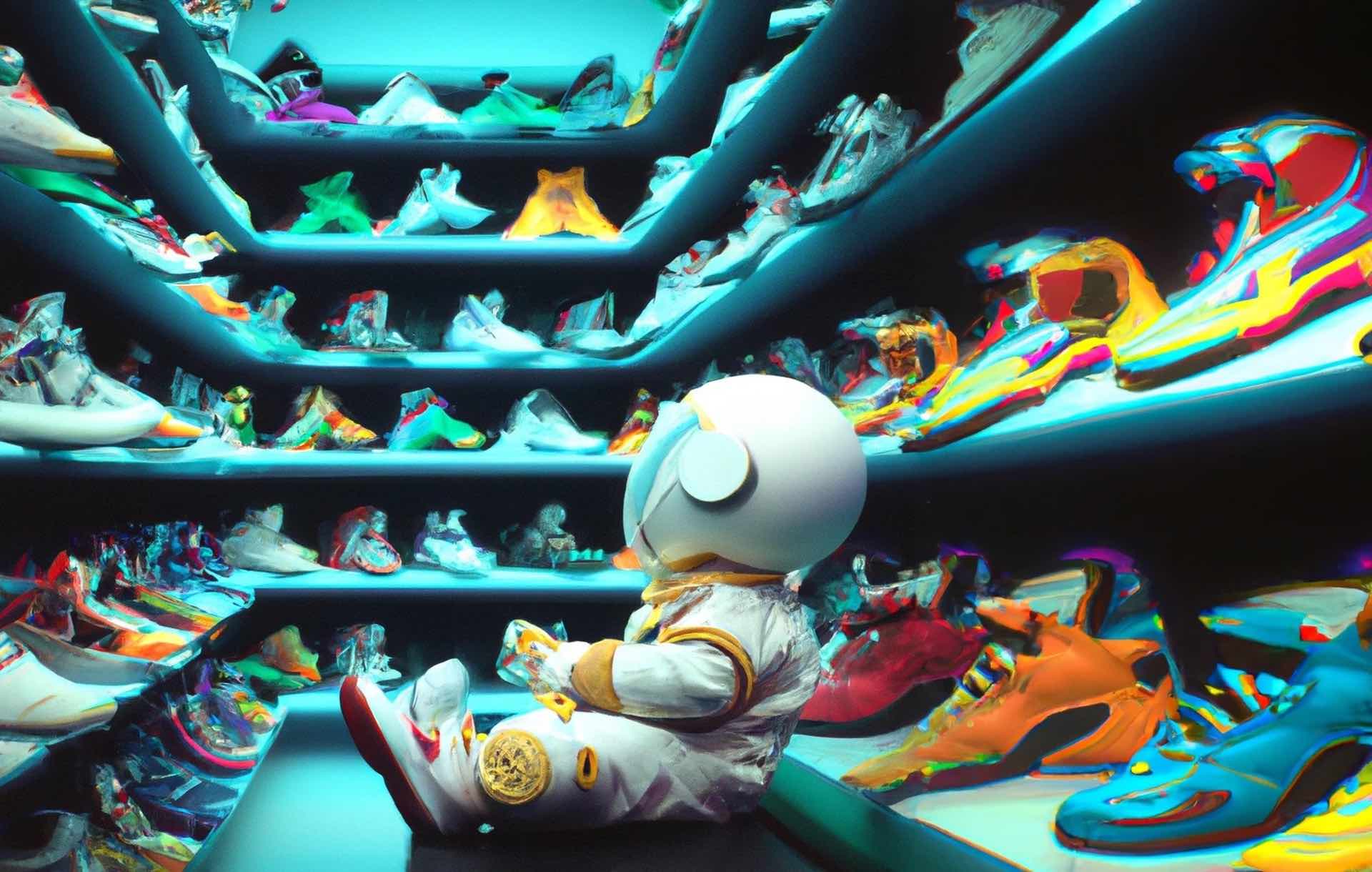
When Shoes Became Stocks
There is a version of the investment story that goes: equities, bonds, real estate, gold, and then the increasingly long tail of alternative assets — fine art, rare whisky, vintage watches, classic cars. In 2026, that tail has grown a new appendage that would have seemed absurd a decade ago: sneakers.
The global sneaker resale market has grown past $30 billion in annual volume. The biggest platforms — StockX, GOAT, and a new generation of blockchain-native marketplaces — process millions of authenticated transactions every year, with bid-ask spreads, index benchmarks, and liquidity profiles that increasingly resemble financial markets. A pair of Air Jordan 1 Retro High OG "Chicago" releases at $180 at Nike and routinely trades on the secondary market for $800 to $1,200 — depending on size, condition, and timing.
That is not a novelty. That is a return on invested capital. And a growing number of collectors, retail investors, and institutional players are treating it as exactly that.
This guide covers what the sneaker investment market actually looks like in 2026 — the mechanics, the data, the risks, and the practical entry points for someone approaching it with a finance mindset rather than a hype mindset.
The Structure of the Market
The sneaker resale ecosystem has matured significantly from its origins in street-level trading. Today it operates through several distinct layers.
Primary market. Limited releases from Nike, Jordan Brand, Adidas, New Balance, and a constellation of smaller brands. Most high-demand drops now use a lottery or SNKRS-app raffle system rather than first-come-first-served queuing, which in theory democratises access but in practice is dominated by informed participants with deep knowledge of release calendars and probability estimation.
Secondary marketplaces. StockX functions as the closest analogue to a stock exchange — real-time bid and ask prices, transaction history, price charts, and market-cap style metrics per model. GOAT occupies the premium end of the market, with deeper authentication infrastructure. Alias, launched in 2024, adds a social layer with portfolio tracking and collector reputation scoring. Each platform takes a fee on transactions (typically 9–10% for sellers), which functions like a trading commission.
Direct peer-to-peer. Platforms like Facebook Marketplace, Depop, and regional equivalents still facilitate significant volume, especially for lower-value or less-hyped items where platform fees would erode margins.
Physical shops. In major cities — Los Angeles, London, Tokyo, New York, Seoul — a network of consignment boutiques operates as the premium tier of the market, catering to buyers who pay a premium for the tactile experience and curator curation.
Blockchain-native platforms. The newest layer, where provenance, ownership, and authentication are recorded on-chain. Platforms built on Ethereum and Solana now issue digital certificates of authenticity alongside physical pairs, and a growing number of brands — Nike's .SWOOSH division most prominently — have built direct programmes around tokenised ownership. This layer matters for high-value items where authentication risk is the dominant concern.
What Drives Sneaker Value
Understanding which factors create and sustain value is the core competency of sneaker investing. Unlike stocks, where value is ultimately anchored to earnings power, sneaker value is a function of cultural capital translated into scarcity economics. The key variables:
Brand heat. Nike and Jordan Brand dominate by volume, but the premium tier has diversified significantly. New Balance experienced a years-long revival driven by celebrity association and deliberate product restraint that has proven durable into 2026. Salomon's transition from hiking to streetwear drove extraordinary returns on limited collabs from 2022 to 2024. Brand cycles matter — reading brand trajectory early is as valuable as any other signal.
Colourway rarity. The same shoe model can have dramatically different market values depending on colourway. "University Blue" Dunk Lows and "Panda" Dunk Lows carry completely different premiums relative to retail despite being the same silhouette.
Collaboration pedigree. Sneaker collabs — Nike x Sacai, Adidas x Wales Bonner, New Balance x Aimé Leon Dore — consistently generate the largest premiums. The best-performing collaborations in the past five years have delivered 300 to 800 per cent returns on retail price. Understanding which brand partnerships carry weight requires tracking the cultural conversation in fashion, art, and music simultaneously.
Size curve. Demand is not uniformly distributed across sizes. Men's sizes 9 to 11 (US) are the most liquid, producing tighter bid-ask spreads and faster transaction times. Unusual sizes — very small men's or very large — are genuinely scarcer and can command premiums, but liquidity is lower and exit risk is higher.
Condition grading. Dead stock (unworn, original box, laces unused) is the benchmark. DS pairs command a significant premium over even lightly worn examples. Authentication platforms have developed standardised grading systems, but condition assessment still involves subjective judgment, particularly for vintage or aged materials.
Cultural moment timing. Sneaker values spike when the relevant cultural context is activated — a celebrity wearing a pair, a film or series placing them prominently, a sports moment tied to the athlete associated with a specific model. The Air Jordan 11 "Concord" trades at elevated prices around every NBA Finals because of its cultural associations. These cycles are partially predictable.
The Data Layer: How AI Has Changed the Analysis
The most significant structural change in sneaker investing over the past two years is the emergence of robust data infrastructure. What was previously a market driven almost entirely by intuition and community knowledge can now be approached with quantitative rigour.
Price history databases. StockX's API and third-party aggregators now provide multi-year price histories with transaction-level granularity. It is possible to run analysis on seasonality, liquidity, return profiles, and correlations that would have been impossible without this infrastructure.
AI-powered authentication. Machine learning models trained on millions of authenticated pairs have made counterfeit detection dramatically more accurate. Platforms now use computer vision to flag suspicious listings before they reach authenticators, reducing the fraud rate and lowering the risk premium for buyers. The practical implication: fakes are harder to move at scale, which has improved overall market integrity.
Predictive pricing tools. Startups like SneakerScan and WhatTheKicks (acquired by StockX in 2025) aggregate social media velocity, search interest, and release calendar data to model expected post-release pricing within 48 to 72 hours of a drop. These tools are not oracles, but they shift the quality of information available to participants meaningfully.
Portfolio analytics. Collector-focused apps now provide portfolio valuation, diversification metrics, and performance attribution — the same functionality you would expect from a brokerage interface applied to pairs of shoes. Tracking returns net of fees across a large collection is no longer a manual spreadsheet exercise.
The Return Profile: What History Tells Us
Like any alternative asset, aggregate data on sneaker returns needs careful interpretation. The distribution is highly skewed — a small number of releases generate enormous returns while the majority perform modestly or negatively.
Top-tier collabs and retros. The best-performing releases — major collab drops, retro releases of iconic silhouettes in original colourways — have historically generated annualised returns in the 20 to 60 per cent range over one to three year holding periods when purchased at retail. The key constraint is access: these are exactly the releases where retail access is hardest to obtain.
Secondary market purchases. Buying on the secondary market (paying above retail) compresses returns significantly. The question becomes whether further appreciation will outpace the premium already paid. Historical data suggests this works reliably only for pieces with strong, consistent cultural anchors — the Jordan 1 Chicago, the Air Max 1 "Anniversary," a handful of collab silhouettes.
Broad market basket. An investor who consistently participated in a diversified basket of moderate-demand releases over the past five years would have achieved roughly 8 to 15 per cent annualised returns — comparable to a diversified equity portfolio, but with meaningful additional complexity, illiquidity, and storage costs.
The downside scenarios. Demand evaporates faster than in traditional assets. A brand that misreads its cultural moment, a collab partner whose reputation collapses, or a broader cultural pivot away from a silhouette can cut valuations by 50 to 80 per cent with little warning. The Yeezy collapse after the Ye controversy is the instructive recent case study — billions in market cap destroyed within weeks.
Building a Sneaker Portfolio: Practical Framework
Approaching sneaker investment with portfolio thinking means applying familiar principles to an unusual asset class.
Start with knowledge, not capital. The most common mistake is allocating money before building domain expertise. The research investment — following release calendars, understanding colourway history, learning brand trajectories, participating in the community — determines whether your capital allocation decisions are informed or speculative. Six months of learning before six months of buying is the advised sequence.
Define your approach. Three basic orientations exist, each with different time horizons and risk profiles:
Retail flip: Win a raffle or queue successfully, sell within days or weeks for the immediate premium. High frequency, modest per-unit returns, requires consistent time investment and raffle luck. Works best for releases with predictable, steady demand.
Medium-term hold: Acquire at or near retail, hold for six to eighteen months waiting for a cultural catalyst to drive appreciation. Lower frequency, higher per-unit return potential, requires thesis formation about what drives appreciation.
Collector-grade investment: Focus on the highest-tier releases — the Jordans, Salomons, and collab pairs that carry genuine cultural permanence. Longer hold periods, less frequent transactions, but the pieces that have historically delivered the most consistent long-term appreciation.
Size selection and liquidity management. Concentrate holdings in the most liquid size range (US 9–11) unless you have specific expertise in size curve dynamics. Illiquid sizes are not necessarily bad investments, but they require a longer time horizon and tolerance for slower exits.
Storage and condition preservation. Proper storage — UV-protected, temperature-stable, away from moisture — is not optional. Degradation in condition directly affects realised value. Serious investors use climate-controlled storage; for a modest collection, a consistent home environment and appropriate sneaker boxes is adequate. Some collectors use silica gel packets to manage humidity; sole yellowing from oxidation is the most common and preventable deterioration.
Fee accounting. Selling fees on major platforms run 9 to 12 per cent. Authentication fees add another one to two per cent. Round-trip transaction costs of 20 per cent or more on a single buy-and-sell cycle mean that short-term trades need to generate substantial appreciation just to break even. Net returns matter, not gross.
Tax treatment. In most jurisdictions, profits from sneaker sales are treated as capital gains. In the UK, CGT rates apply. In the US, short-term gains (under one year) are taxed as ordinary income. Record-keeping — purchase price, sale price, platform fees, date of transaction — is essential and often underestimated.
The Blockchain Authentication Layer
The intersection of sneakers and blockchain technology has moved well past the hype cycle into practical application. Several developments are material.
Nike .SWOOSH and CryptoKicks. Nike holds patents on "CryptoKicks" — a system linking physical sneakers to corresponding NFTs. The .SWOOSH platform, launched in 2022 and expanded significantly in 2024 and 2025, enables owners to connect digital and physical ownership. While still primarily a loyalty and community platform, the infrastructure for on-chain provenance is now production-grade.
Dust Labs and community authentication. Projects like Dust Labs (partnered with New Balance for certain releases) allow authenticated pairs to carry verifiable on-chain records of ownership history. For high-value vintage pieces, the ability to trace provenance reduces authentication risk and has begun to command a measurable premium.
Tokenised fractional ownership. A small number of platforms have experimented with fractional ownership of high-value pairs — effectively securitising a pair of ultra-rare sneakers and selling shares to multiple investors. Volume is currently modest and the regulatory environment is unclear in most jurisdictions, but it represents a logical extension of the tokenisation trend visible across alternative assets.
The practical implication today. For most investors, blockchain authentication matters primarily as a risk-reduction tool for expensive acquisitions — it is evidence of authenticity that is harder to fake than physical inspection alone. The active trading angle of NFT-linked sneakers is less developed than the authentication use case.
Platforms and Ecosystem
StockX. The dominant exchange for mainstream releases. Best for price discovery, data, and liquidity on high-volume models. Authentication is good but not infallible at scale. Fees are competitive.
GOAT. Premium positioning with deeper authentication rigour for rare and vintage pairs. Better for high-value acquisitions where authentication confidence is worth a higher platform fee.
Alias. The newest major entrant, with community-native features including reputation scoring and portfolio benchmarking. Growing rapidly among data-oriented collectors.
Alias Vault. A custody and storage product from Alias that allows investors to hold authenticated pairs in climate-controlled facilities without taking physical possession. Reduces storage and condition risk; adds counterparty risk.
Stadium Goods (LVMH). The premium physical-retail layer, acquired by LVMH. Caters to international luxury buyers and provides a price floor for certain heritage pieces.
Regional platforms. Novelship (Southeast Asia), Solestage (Japan), and Sasom (Thailand) are important for regional releases that do not achieve full global distribution and can have significant arbitrage opportunities for informed participants.
The Risks Worth Taking Seriously
Demand is cultural, not fundamental. There is no earnings floor beneath a sneaker's value. A silhouette can go from commanding a 300 per cent premium to trading below retail within a season if cultural winds shift. This is the defining risk and has no exact parallel in traditional asset classes.
Counterfeiting remains a real threat. Despite progress in authentication technology, sophisticated fakes continue to circulate. Purchasing from authenticated platforms mitigates but does not eliminate this risk. For very high-value vintage pairs, independent expert authentication before purchase is advisable.
Platform risk. A platform that holds physical inventory (like Alias Vault) introduces counterparty risk — what happens to your holdings if the platform faces financial difficulty? This is not hypothetical; several smaller platforms have ceased operations over the past three years with disputed outcomes for consignment holders.
Liquidity illusion. In bull markets, sneaker liquidity appears good. In periods of reduced hype or broad economic stress, the bid-ask spread on secondary market items can widen dramatically and some items simply find no buyers at expected prices. Sneakers are not liquid in the way equities are liquid.
Time cost. Raffle participation, authentication management, platform fee optimisation, storage, and record-keeping consume real time. The effective hourly return on a small sneaker portfolio may be significantly lower than a simple index fund, once time cost is factored in.
Is Sneaker Investing Right for You?
The honest answer is: it depends on what else you bring to the table.
If you already have the cultural knowledge — you follow releases, understand the brand landscape, have community connections — the incremental effort to approach collecting with investment discipline is modest. The knowledge moat is already built.
If you are starting from zero on domain expertise, the upfront investment to become genuinely informed before becoming genuinely exposed is substantial. The return potential does not justify that learning cost for someone who would not be interested in the space independently.
The optimal profile for a sneaker investor in 2026 is someone who sits at the intersection of cultural knowledge and financial literacy — who reads both Sneaker News and the Wall Street Journal, who can assess brand trajectory and discount rates simultaneously.
For those who fit that profile, the sneaker market in 2026 offers something genuinely interesting: a large, liquid, data-rich alternative asset class with persistent premium generation, meaningful barriers to entry for uninformed participants, and a structural supply constraint (limited drops are definitionally scarce) that is not available in most financial markets.
The shoes on your shelf might be the best returning asset in your portfolio. Understanding why — and which ones, and for how long — is the work.
The Practical Starting Point
If you are approaching this seriously for the first time:
-
Spend sixty days learning before spending any money. Follow StockX market data daily. Subscribe to Kicks on Fire and Sneaker News for release intelligence. Join one or two Discord communities focused on reselling analytics, not hype.
-
Start with one or two retail flips. Enter a raffle for a release you have researched, sell within a week or two if you win. The goal is not profit (though profit is welcome) but learning the mechanics of the transaction end-to-end — raffle process, authentication steps, platform interface, fee calculation, tax implications.
-
Build a thesis before building a position. If you move toward medium-term holds, you need a view on what catalyst will drive appreciation. "I think this shoe is undervalued" is not a thesis. "This collab is trading below its historical premium relative to comparable releases and the designer has a runway show in October that should drive renewed attention" is a thesis.
-
Set a position limit. Sneakers should be a satellite position in a diversified alternative asset allocation, not a core holding. The standard guidance applies: allocate only what you can afford to hold for the full intended period without needing the liquidity for other purposes.
The market rewards those who combine genuine cultural knowledge with financial rigour. In 2026, those tools — data infrastructure, authentication technology, analytics platforms — have never been more accessible to the individual investor.
The floor is a pair of shoes. The ceiling is determined by how seriously you take the work.