The Quiet Arrival
There was no single announcement, no dramatic keynote moment that marked the transition. Instead, humanoid robots entered the global workforce the way most profound changes actually happen: gradually, then all at once.
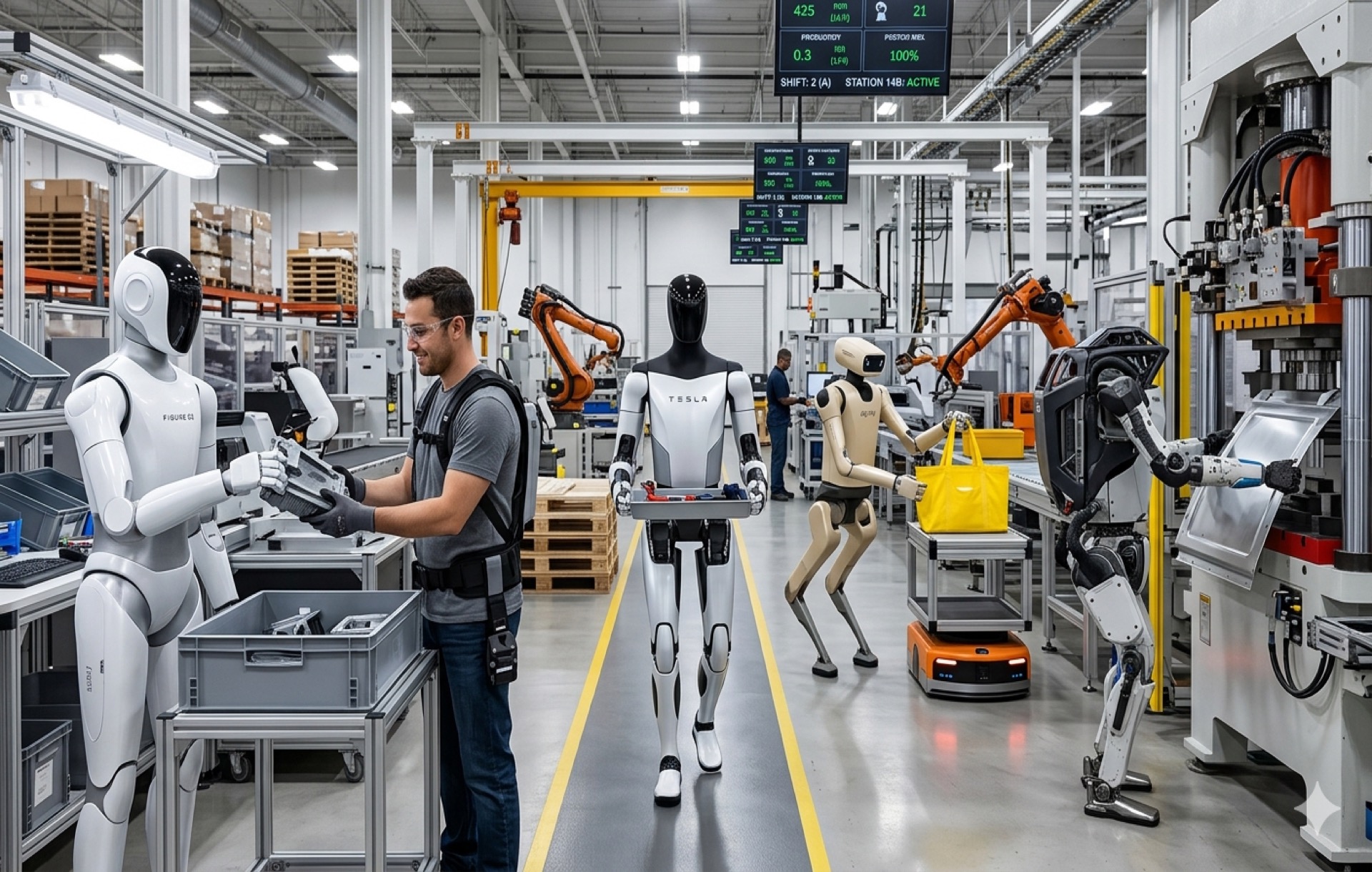
In early 2025, fewer than 2,000 humanoid robots were operating in commercial environments worldwide. By the close of 2025, that number had crossed 15,000. As of mid-2026, industry estimates place the deployed fleet somewhere between 40,000 and 55,000 units, spread across automotive manufacturing, electronics assembly, logistics warehousing, and — most recently — the first commercial deployments in food service and retail.
The numbers remain modest relative to the 3.4 billion humans who constitute the global labor force. But the trajectory is not modest. Every major robot manufacturer is reporting lead times measured in months, not years. Unit economics are collapsing faster than the most aggressive forecasts projected. And the capability curve — the range of physical tasks a humanoid robot can reliably perform — is expanding in a way that now concerns economists who spent the past decade arguing the technology was "still decades away."
This piece examines where the technology actually stands, which platforms are leading the deployment wave, what the genuine economic disruptions look like, and — for investors paying attention — where the value is likely to accumulate.
Why Humanoid, and Why Now
The case for humanoid robots has always been elegant in theory: the physical world was built by and for human bodies. Factories, warehouses, hospitals, kitchens, offices — all of this infrastructure was designed around hands that can grip, legs that can navigate stairs, and eyes positioned at human height. A robot shaped like a human can, in principle, operate in all of these environments without rebuilding the environment first.
The counterargument — that specialized robots do individual tasks better than generalist humanoids — remains partially valid. A robotic arm purpose-built for spot welding outperforms a humanoid at spot welding. A conveyor system optimized for package sorting outperforms a humanoid at package sorting.
But the calculus changes entirely when you consider the total cost of physical infrastructure reconfiguration. Deploying purpose-built robots requires redesigning workflows, retooling facilities, and often constructing new physical environments. Deploying a humanoid that can walk into an existing facility and begin performing useful work within days — even if it performs each task at 80% of specialist efficiency — frequently delivers a better return on investment when total implementation costs are factored in.
Three technological developments converged to make this economics viable in 2025–2026:
| Development | Why It Matters |
|---|---|
| Foundation models for robotics | The same architectural breakthroughs that powered large language models have been applied to robot control policies, enabling robots to generalize from demonstrations rather than requiring hand-coded behaviors for every task |
| Sim-to-real transfer at scale | Robots trained in simulation for billions of hours can now transfer learned behaviors to physical hardware with high fidelity, compressing training timelines from years to weeks |
| Commodity hardware cost collapse | Actuator, sensor, and compute costs have followed the same downward trajectory as consumer electronics; a robot that cost $350,000 to build in 2023 can now be manufactured for under $80,000 |
These three forces are mutually reinforcing. Cheaper hardware enables larger fleets, which generates more real-world training data, which improves foundation models, which makes individual robots more capable, which justifies higher deployment volumes, which drives hardware costs further down. The flywheel has engaged.
The Leading Platforms
Figure AI
Figure AI has emerged as the most closely watched humanoid robotics company in 2026, not because it has the largest deployment but because its technical execution has been the most credible. The company's partnership with BMW — which began in 2024 with a limited pilot at the Spartanburg plant in South Carolina — has expanded to three BMW facilities and demonstrated something that had not been done before at commercial scale: a general-purpose humanoid performing genuine production tasks alongside human workers without safety incidents.
Figure's robots are now handling parts transfer, component inspection, and light assembly tasks. BMW has publicly stated that Figure units achieve productivity levels equivalent to approximately 65–70% of a human worker for these specific tasks — a figure that was considered optimistic as recently as 18 months ago.
More notable than the current performance numbers is the learning curve. Figure's VP of Engineering noted in March 2026 that the robots deployed in BMW plants today are performing tasks that were not in their training repertoire 90 days ago, learned through a combination of human demonstration and self-supervised practice during non-production hours. The robots are, in a measurable sense, getting better at their jobs.
Tesla Optimus
Tesla's approach to humanoid robotics reflects the company's broader philosophy: vertical integration at scale, prioritizing cost reduction above all else. Where Figure AI raised hundreds of millions in venture capital and focused on enterprise deployment contracts, Tesla has treated Optimus as an internal manufacturing asset first — deploying robots in its own Gigafactories before attempting external sales.
The strategy has generated early advantages. Tesla's Fremont and Texas facilities have become the world's largest real-world humanoid robot training environments, with reportedly over 8,000 Optimus units in various stages of deployment as of Q1 2026. The sheer volume of operational hours — and the data it generates — has allowed Tesla to iterate on Optimus hardware and software at a pace that externally funded competitors struggle to match.
Tesla has announced that external commercial sales of Optimus will begin in Q4 2026, with initial pricing targeted at $25,000–$35,000 per unit — a figure that, if achieved at volume, would represent the most significant unit economics disruption in the industry's history.
Boston Dynamics and the Atlas Pivot
Boston Dynamics built its reputation on extraordinary locomotion research. The original Atlas was a marvel of dynamic control — capable of backflips and parkour demonstrations that seemed to defy the physics of electromechanical systems. What it was not, for most of its history, was commercially useful.
The 2024 transition to a fully electric Atlas, paired with a commercial deployment model through Hyundai's manufacturing network, represents Boston Dynamics's attempt to translate research excellence into business results. Early deployments in Hyundai automotive plants have been cautious and heavily supervised — Boston Dynamics's engineers are characteristically reluctant to overstate capabilities — but the platform's dexterity on complex manipulation tasks has impressed independent observers.
Boston Dynamics's competitive position in 2026 is strongest in high-complexity, low-volume environments where task difficulty justifies premium pricing and where the company's engineering reputation provides customer confidence.
Chinese Competition: Unitree and Beyond
The humanoid robotics landscape cannot be discussed without acknowledging the rapid progression of Chinese manufacturers. Unitree Robotics, which first gained attention for its low-cost quadruped robots, has released a humanoid platform — the H1 and G1 series — at price points that undercut Western competitors by 40–60%.
The capabilities of Chinese humanoid platforms in 2026 remain somewhat behind the frontier set by Figure and Tesla Optimus in terms of task sophistication and reliability. But the gap is narrowing, and the combination of government support, manufacturing scale, and aggressive pricing suggests that Chinese humanoid robots will be significant market participants within 18–24 months.
The Labor Economics: What Is Actually at Risk
The labor displacement narrative around humanoid robots generates more heat than light. Two opposing camps have staked out positions that are both, in different ways, wrong.
The maximalist disruption view — "robots will eliminate most jobs within a decade" — ignores the practical realities of deployment speed, reliability requirements, regulatory approval processes, and the enormous variety of physical tasks that remain beyond current robotic capabilities.
The dismissive view — "we've been hearing about robot job displacement for 50 years and it hasn't happened" — ignores the genuine capability discontinuity represented by foundation model-driven robots that can generalize across tasks and environments.
The reality, as best the evidence suggests, looks more like this:
High near-term displacement risk (2026–2030):
- Repetitive warehouse and logistics tasks — pick-and-pack operations, inventory management, item sortation. This sector is already experiencing significant automation pressure from specialized systems; humanoids add flexibility to existing automation economics.
- Defined manufacturing sub-tasks — material handling, component transfer, quality inspection in controlled environments. These are tasks with clear success criteria, low consequence of individual errors, and high volume.
- Structured food service roles — dishwashing, food preparation in standardized environments (fast food, commissary kitchens). Several fast food chains have announced or are piloting robot-assisted kitchen operations.
Moderate medium-term risk (2030–2035):
- Construction labor in standardized contexts — concrete work, framing, tiling in repetitive residential construction formats.
- Agricultural harvesting — particularly for crops where robotic harvest has historically been blocked by gentle manipulation requirements; foundation model dexterity is closing this gap faster than anticipated.
- Retail stocking and inventory tasks — high repeatability in environments that can be partially optimized for robot navigation.
Low near-term risk, significant uncertainty beyond 2030:
- Complex care roles — elder care, childcare, nursing assistance. These require social and physical adaptability that current systems cannot reliably provide, and regulatory frameworks are likely to impose additional barriers.
- Non-routine cognitive-physical hybrid work — trades like plumbing, electrical work, HVAC, which require significant problem-solving embedded in physical execution.
- Customer-facing service roles — the social complexity and unpredictability of human customer interaction remains genuinely difficult for current systems.
The honest summary: the labor market impact of humanoid robots through 2030 will be real and concentrated in specific sectors, but not the civilizational disruption that the most alarming headlines suggest. The greater risks lie in the 2030–2040 window, when capability improvements, cost reductions, and accumulated deployment experience combine.
The Investment Landscape
For investors, humanoid robotics presents a classic high-potential, high-uncertainty opportunity. The companies building the most capable platforms are largely private. The public markets exposure is primarily through component suppliers, diversified technology companies, and conglomerates where robotics is one division among many.
Several investment themes deserve consideration:
The Picks-and-Shovels Approach
Rather than attempting to identify which humanoid platform will "win" — a question that may not have a clean answer, given the likelihood of market segmentation by use case and geography — investors may find better risk-adjusted returns in enabling technologies:
- Actuator manufacturers — The harmonic drive and linear actuator suppliers that produce the mechanical components inside robots face robust demand from every platform simultaneously. Companies like Nabtesco (Japan) and Schaeffler (Germany) have seen their robotics divisions grow substantially.
- Semiconductor providers — The inference compute inside deployed robots relies heavily on chips optimized for low-power, real-time neural network execution. NVIDIA's Jetson platform dominates current deployments, but competitors are emerging.
- Sensor technology — Force-torque sensors, tactile sensing arrays, and depth cameras are critical enabling components. Femto and similar depth sensor specialists have seen order books expand dramatically.
Software and Simulation
The foundation model revolution in robotics has elevated the importance of software infrastructure:
- Physics simulation platforms — NVIDIA's Isaac Sim and similar environments where robots accumulate training hours have become essential infrastructure. The more capable simulation, the faster robots improve.
- Robot fleet management software — Managing a fleet of 500 humanoid robots across multiple facilities requires sophisticated orchestration, monitoring, and task allocation software. This market barely existed two years ago and is growing rapidly.
- Training data and annotation — As with language models, high-quality training data for robot manipulation tasks commands a premium. Companies specializing in robotic training data curation have become acquisition targets.
The Deployment Services Layer
An underappreciated opportunity lies in the deployment, integration, and maintenance layer. Most manufacturers do not want to manage the operational complexity of humanoid robot fleets — they want to buy capability as a service. This creates opportunity for companies that can:
- Integrate robots into existing factory workflows without disrupting production
- Provide ongoing maintenance and repair services
- Manage the data pipelines that enable continuous improvement
- Navigate the regulatory environments that govern robot deployment in various industries
This service layer is where durable margins are likely to emerge, mirroring the pattern observed in industrial automation more broadly.
The Regulatory and Ethical Frontier
The deployment of autonomous physical agents that work alongside humans raises genuine safety, liability, and ethical questions that the industry is only beginning to address.
Safety standards are the most urgent near-term challenge. When a humanoid robot drops a component and a worker is injured, who bears liability — the manufacturer, the deploying company, or the facility operator? Current product liability frameworks were not designed for autonomous agents, and the legal ambiguity is creating caution among enterprise customers who might otherwise move faster.
The EU's AI Act, which came into force in 2025, includes provisions for autonomous robots operating in shared human environments, but implementation guidance remains inconsistent across member states. The United States has no comparable federal framework; regulation has defaulted to existing OSHA standards and a patchwork of state-level rules that create compliance complexity for companies deploying nationally.
Labor relations are a second significant challenge. The deployment of humanoid robots by unionized manufacturers has required negotiation with labor organizations in several cases. The agreements reached so far suggest a pattern: robots are deployed in tasks identified as dangerous or physically arduous first, and displacement is managed through attrition rather than layoffs. This approach reduces near-term conflict but does not resolve the longer-term structural question of what happens when robot capabilities expand beyond the initial deployment envelope.
The surveillance dimension deserves attention. Humanoid robots deployed in workplaces are, by definition, equipped with cameras and sensors that observe the physical environment continuously. The data governance implications — who owns the footage, how it can be used, whether it can be shared with third parties — have not been resolved in most deployment contexts.
What Changes for Knowledge Workers
The assumption that humanoid robots primarily affect physical laborers misses an important dynamic: the deployment of physical AI accelerates the economic pressure on knowledge workers simultaneously.
The mechanism is indirect but powerful. When robots handle physical tasks currently performed by humans, they generate a data-rich record of physical work — tasks completed, time taken, quality metrics, error patterns. This data feeds improvement cycles that make subsequent robots more capable. The organizational learning that currently lives in the heads of experienced workers — the tacit knowledge of how to handle a difficult component, how to adapt to an unusual situation — becomes increasingly captured in robot training datasets.
The knowledge worker parallel: as language models have captured and replicated a widening range of cognitive tasks, the economic pressure on certain knowledge work categories has intensified. The robotics deployment wave may have an analogous effect on physical skill domains, accelerating the documentation and digitization of practical know-how that has historically been difficult to transfer.
For professionals watching this evolution, the question is less "will robots take my job?" and more "what does human value-add look like when physical and cognitive execution can be increasingly automated?" The answers are still being worked out, but they consistently involve creativity, judgment in genuinely novel situations, relationship management, and the kind of contextual improvisation that current systems handle poorly.
Key Takeaways
- The 2025–2026 deployment wave is real, commercially validated, and accelerating. The technology has crossed from research demonstration to operational deployment at scale, with credible enterprise customers reporting genuine productivity gains.
- Unit economics are collapsing faster than forecasts. The $25,000 price point that Tesla is targeting for Optimus would, if achieved, be transformative for the total addressable market.
- Near-term labor displacement is concentrated, not universal. Repetitive warehouse, manufacturing sub-tasks, and structured food service face genuine disruption before 2030. Complex, adaptive, and social roles face much longer timelines.
- The investment opportunity is diffuse. Platform winners are largely private; accessible value may be better captured through component suppliers, simulation software, and deployment services rather than direct bets on robot manufacturers.
- Regulatory and liability frameworks are lagging deployment reality. This creates near-term friction that slows adoption but also creates opportunity for companies that invest in compliance competency early.
- The convergence of physical AI and language AI is the deeper story. Humanoid robots are not a separate technological trend from large language models — they are the same models, extended into physical embodiment. The implications of that convergence will unfold across the next decade in ways that current forecasts are almost certainly underestimating.
The robots clocking in today are not the robots that will be clocking in five years from now. That trajectory — the rate of improvement, not the current capability level — is what deserves sustained attention.