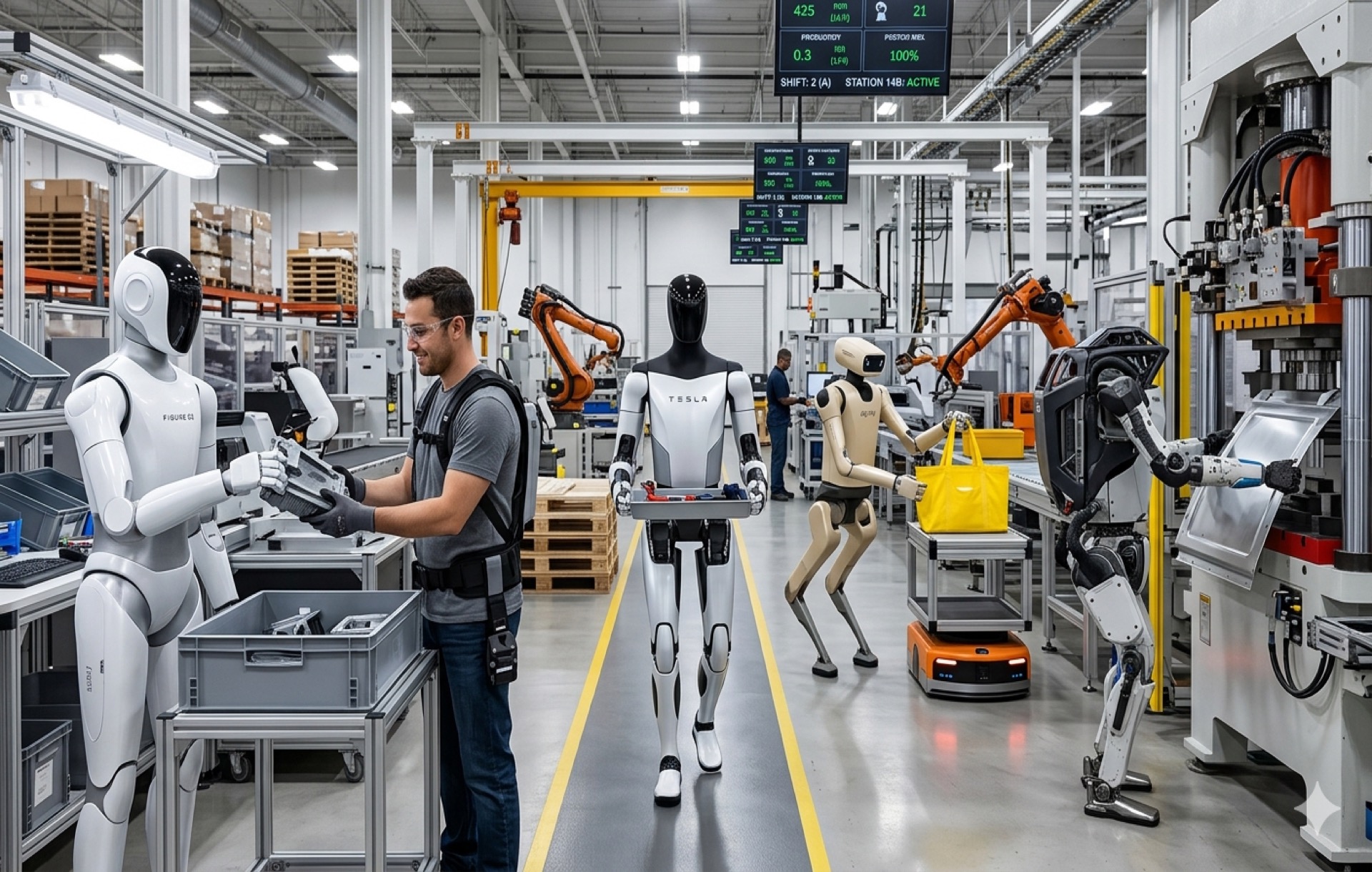
The Moment Nobody Announced
There was no press conference. No landmark bill. No single robot that went viral and changed the conversation. The humanoid robot revolution happened the way Ernest Hemingway's fictional bankruptcy did — gradually, then all at once.
In January 2026, Figure AI reported that its robots had completed over one million cumulative hours of autonomous task execution across BMW Group's Spartanburg plant and two Tier-1 automotive suppliers. Tesla confirmed that Optimus units had taken on 35 distinct assembly sub-tasks across its Fremont and Gigafactories. Agility Robotics' Digit was operating in seven Amazon fulfilment centers, with a contract expansion covering 15 more. 1X Technologies shipped its first commercial fleet to a Scandinavian logistics company. Boston Dynamics announced Atlas was moving from R&D to commercial leasing.
None of these headlines dominated a single news cycle. Together, they represent an inflection point as significant as the smartphone launch or the cloud migration — a moment when a technology category crosses from early adopters to operational scale.
This article examines what is actually happening, why the timing is not accidental, and what the next 24 months look like for the technology, the economy, and the people whose work is being transformed.
Why 2026? The Convergence Thesis
The humanoid robot category existed for decades as an engineering novelty. Honda's ASIMO debuted in 2000. Boston Dynamics' Atlas has been doing backflips since 2017. The capability was real. The deployment was not. What changed?
Three technological waves converged simultaneously in 2024-2025, and their compound effect is now being felt across the economy.
| Enabling Technology | 2020 State | 2026 State | The Delta |
|---|---|---|---|
| Foundation models | GPT-3, narrow task models | Embodied AI with physical world priors | Robots can reason about tasks, not just execute scripts |
| Actuator technology | Expensive, fragile hydraulics | Electric actuators at $200-500/joint | Cost-per-joint down 80%; units can be repaired on-site |
| Battery energy density | ~250 Wh/kg | ~450 Wh/kg | 4-6 hour operational shifts without recharge |
| Sim-to-real transfer | High gap (robot behavior in sim ≠ reality) | Near-zero gap with physics engines trained on real sensor data | Training in simulation translates directly to deployment |
| Vision-language-action models | Research prototypes | Production-grade VLA models | Robots read instructions, interpret environments, execute |
The critical enabler was not any single component — it was the foundation model moment applied to physical AI. When researchers discovered they could pre-train robots on vast datasets of video of humans performing tasks, then fine-tune on a small number of robot demonstrations, the cost and time required to teach a robot a new skill collapsed from months to days. Physical AI borrowed the recipe that made LLMs generalize — and it worked.
The Five Frontrunners: Where Each Company Stands
The humanoid robot market is not winner-take-all. Different machines serve different use cases, and the competitive landscape in April 2026 looks more like the early smartphone era — multiple viable platforms, each with different architectural bets — than a monopoly.
Figure AI — The Speed Merchant
Figure has moved faster than any company in the category from demo to deployment. Its second-generation robot, Figure 02, is operating in BMW Group's Spartanburg plant handling body shop assembly tasks: picking parts from containers, presenting them to human workers, and placing components into vehicle bodies with sub-millimeter repeatability.
What makes Figure notable is not the machine itself — it's the AI stack. Figure partnered with OpenAI to develop a proprietary visual language model for robot cognition, allowing Figure 02 to interpret spoken instructions, ask clarifying questions, explain its own actions, and flag situations outside its confidence envelope for human oversight.
In a widely circulated demo from February 2026, a Figure 02 unit asked a supervisor "I am not certain this is the correct bracket. Should I proceed?" before placing a part — the first time a deployed industrial robot initiated an unprompted safety check using natural language. That interaction was logged in over 50,000 posts across engineering communities. It was the moment the category felt different.
Current deployment: ~400 units across automotive partners. Target: 2,000 units by end of 2026.
Tesla Optimus — The Vertical Integration Play
Tesla's advantage in humanoid robotics has nothing to do with humanoid robotics. It has everything to do with Tesla's existing supply chain, manufacturing expertise, and self-supervised AI training at scale.
Optimus Gen 3, announced at Tesla's Q4 2025 earnings call, incorporates lessons from over 1.5 billion miles of autonomous driving data — not directly, but via shared infrastructure for training perception models on real-world sensor data. Tesla's internal cost target for Optimus is below $20,000 per unit at scale, which would be the first humanoid robot priced within reach of small and medium manufacturers.
The current deployment at Fremont and Gigafactories focuses on logistics tasks — moving parts between workstations, supplying materials to assembly lines, and handling repetitive transfer tasks that human workers find ergonomically harmful. Tesla has explicitly stated Optimus will not replace workers on the critical assembly path in the near term, but will absorb the "connective tissue" tasks that currently consume 15-20% of line worker time.
Elon Musk reiterated in March 2026 that Tesla expects to produce 100,000 Optimus units in 2026 — a number most analysts view as aggressive, but directionally credible given Tesla's manufacturing track record.
Current deployment: Internal only (all Tesla facilities). First external commercial sales: H2 2026.
Agility Robotics — The Warehouse Specialist
Agility's Digit was designed for one environment: the logistics warehouse. Lower center of gravity, optimized for bin-picking and pallet manipulation, and engineered to work alongside humans in existing warehouse layouts without retrofitting the infrastructure. This narrow focus is its competitive advantage.
Amazon's partnership with Agility — first announced in 2023 — has quietly become the largest humanoid robot deployment in commercial history by unit count. With Digit units operating across 22 Amazon fulfillment centers as of Q1 2026, Agility has accumulated more real-world operating hours than any competitor.
The data from those deployments is the asset. Agility's training pipeline ingests telemetry from every operational Digit unit, continuously improving the policy models that govern how robots handle new items, navigate around human co-workers, and manage edge cases. Every hour of deployment makes the fleet smarter. This flywheel — operational data improving AI, improving performance, expanding deployment — is the same dynamic that made Tesla's FSD strategy defensible.
Current deployment: ~1,800 units across Amazon network. Agility confirmed expansion to non-Amazon partners in Q2 2026.
1X Technologies — The Safety-First Challenger
Norwegian startup 1X takes the most conservative approach to deployment in the category. Its robot, Neo, is explicitly designed for human-adjacent environments — not isolated factory floors, but settings where robots and people work in close physical proximity: retail, elder care support, and light commercial tasks.
1X's philosophical position is that most humanoid robot companies are optimizing for task completion speed when they should be optimizing for trust building. Its robots move deliberately, telegraph their intentions before moving into a human's space, and are designed to stop at the first sign of ambiguity rather than attempt and potentially fail.
This conservatism has attracted a different class of customer. In March 2026, 1X announced a pilot with a large Nordic grocery chain to deploy Neo in stock replenishment roles, and a healthcare systems partnership for after-hours logistics in hospital corridors. These are environments where a single mistake has consequences beyond the operational — they affect the public's willingness to accept robots in shared spaces at all.
Current deployment: ~300 units across pilots in logistics and healthcare. Focus on European expansion.
Boston Dynamics Atlas — The Technology Benchmark
Boston Dynamics has been the technical reference point for humanoid robotics for over a decade. Its Atlas robot can run, jump, do backflips, and navigate uneven terrain with capabilities that no competitor has matched. That capability, however, came at a price — literally. First-generation Atlas units were priced in the hundreds of thousands of dollars and required specialized maintenance.
The 2026 commercial leasing program reflects a strategic pivot. Boston Dynamics is positioning Atlas not as a production workhorse but as a high-capability specialist for tasks that require mobility and dexterity beyond what cost-optimized competitors can achieve: construction site inspection, hazardous material handling, infrastructure inspection, and defense logistics.
This positions Boston Dynamics not in direct competition with Figure or Agility for automotive and warehouse customers, but in the niche where price is secondary to capability — and where the addressable market, while smaller, commands premium contracts.
Current deployment: Limited commercial leasing, primarily construction and defense pilots. Parent company Hyundai has committed $5B to expanding manufacturing capacity.
Economic Impact: Who Gains, Who Adapts, and What the Transition Looks Like
The labor implications of humanoid robots are generating both genuine anxiety and genuine opportunity. A grounded analysis requires separating three distinct categories of impact.
The Tasks Being Automated First
| Task Category | Why It's First | Industries Affected |
|---|---|---|
| Ergonomically harmful repetitive work | High injury rate, high turnover — companies are motivated | Manufacturing, logistics |
| Predictable pick-and-place in structured environments | Low variability makes AI training tractable | Warehousing, fulfillment |
| Material transport between fixed locations | No manipulation dexterity required | All industrial settings |
| Inspection tasks in hazardous environments | Human safety argument is compelling | Oil & gas, construction, utilities |
| After-hours logistics (hospitals, retail) | No human co-presence removes complexity | Healthcare, retail |
What is not being automated first: Customer-facing roles, tasks requiring social judgment, skilled trades with high variability (plumbing, electrical), care work, roles requiring legal accountability. These are not beyond robots — they are simply beyond the current reliability threshold for commercial deployment.
The Economic Arithmetic
The business case for humanoid robot deployment is already positive in specific contexts. At Figure AI's reported lease rate of approximately $3,000-$5,000 per unit per month — covering the robot, maintenance, software updates, and insurance — a single unit performing two shifts of work displaces approximately $8,000-$12,000 per month in fully-loaded labor cost in US manufacturing.
That 2-3x labor cost advantage, combined with zero sick days, no benefits overhead, and compounding capability improvements, creates a straightforward financial case for manufacturers operating at scale.
| Cost Comparison | Human Worker (US Manufacturing) | Humanoid Robot (2026 Lease) |
|---|---|---|
| Monthly labor cost (fully loaded) | $8,000-$12,000 | $3,000-$5,000 |
| Training time for new task | 1-3 weeks | 1-3 days (simulation + fine-tuning) |
| Injury/absence risk | Significant | Maintenance downtime only |
| Scalability | Limited by hiring market | Capital-limited only |
| Peak demand flexibility | Overtime premium | No additional cost |
The counterargument — that robots displace workers who then have no income to buy the goods being produced — is real and important. It is also not new. Every major automation wave since the industrial revolution has produced this concern, and every wave has ultimately generated more employment than it eliminated, though always with painful transition periods for displaced workers.
The difference this time may be the speed of the transition. Previous automation waves played out over decades. The humanoid robot deployment curve is measured in years. That compression demands policy responses — retraining programs, portable benefits, income smoothing — that have not yet kept pace with the technology.
The Regulatory and Safety Landscape
Humanoid robots operating alongside humans in commercial environments represent a new category of regulated risk. The frameworks governing this space are evolving in real time.
ISO/TS 15066 — the technical specification governing collaborative robot safety — was written for fixed industrial arms, not mobile, dexterous humanoids. Standards bodies in the US, EU, and Japan are actively drafting humanoid-specific standards, but the process is expected to take 18-24 months.
In the interim, companies are navigating deployment through three mechanisms:
- Walled environments — deploying robots in physically separated zones where human workers are excluded during robot operation
- Speed and force limitation — capping robot speed in human-adjacent operation at levels where an accidental contact causes no injury
- Contractual liability frameworks — manufacturers accepting operational liability in exchange for telemetry access, which funds the safety research
The EU's AI Act (fully in force since 2025) classifies humanoid robots in certain commercial settings as high-risk AI systems, requiring conformity assessments, transparency obligations, and human oversight mechanisms. This has slowed European deployment relative to the US and Asia — but has also produced more rigorous safety documentation that may become the global reference standard.
What the Next 24 Months Look Like
The category is transitioning from proof-of-concept to operational scale. The next inflection point is not a new robot — it is the ecosystem buildout that makes robots manageable at fleet scale.
The three developments most worth watching:
1. Fleet management platforms. Managing 50 robots in one plant is an engineering challenge. Managing 5,000 robots across 100 facilities is a software business. The companies building robot fleet management infrastructure — monitoring, predictive maintenance, task allocation, safety incident review — are positioned to capture significant value regardless of which robot hardware wins.
2. The fine-tuning marketplaces. Just as app stores created economic value on top of smartphone platforms, marketplaces for robot task policies are emerging. Companies with specific domain expertise (food processing, pharmaceutical handling, circuit board assembly) are developing fine-tuned AI policies for those tasks and licensing them to robot operators. The robot is the hardware; the task policy is the software.
3. Insurance and financing products. Humanoid robot lease agreements currently require large corporate balance sheets. As the category matures, robot-as-a-service financing products and operational insurance will open the market to smaller manufacturers — the long tail that represents the majority of global manufacturing employment.
Key Takeaways
- The inflection has already happened. Q1 2026 marked the first quarter in which humanoid robot deployments generated operationally significant output across multiple industries simultaneously. The debate has shifted from "will this work?" to "how fast will this scale?"
- No single winner exists yet. Figure, Tesla, Agility, 1X, and Boston Dynamics each have defensible positions in different segments. The market will likely support 3-5 major platforms — not a monopoly.
- The labor impact is real but phased. The tasks being automated first are the ones humans found most harmful, repetitive, or dangerous. Skilled judgment-intensive work remains beyond near-term deployment horizons.
- The software layer is the emerging battleground. The robot that wins the hardware market may not capture the most value. Fleet management, task policy marketplaces, and financing infrastructure will determine who extracts margin from the category long-term.
- Speed is the policy challenge. Previous automation transitions unfolded over decades. This one is unfolding over years. The institutions — retraining programs, social safety nets, regulatory frameworks — were not designed for this pace and will need to adapt faster than they have historically.
The factory floor of 2028 will look materially different from the one of 2024. The transition is not a future risk to plan for — it is a present reality to navigate.