Executive Summary
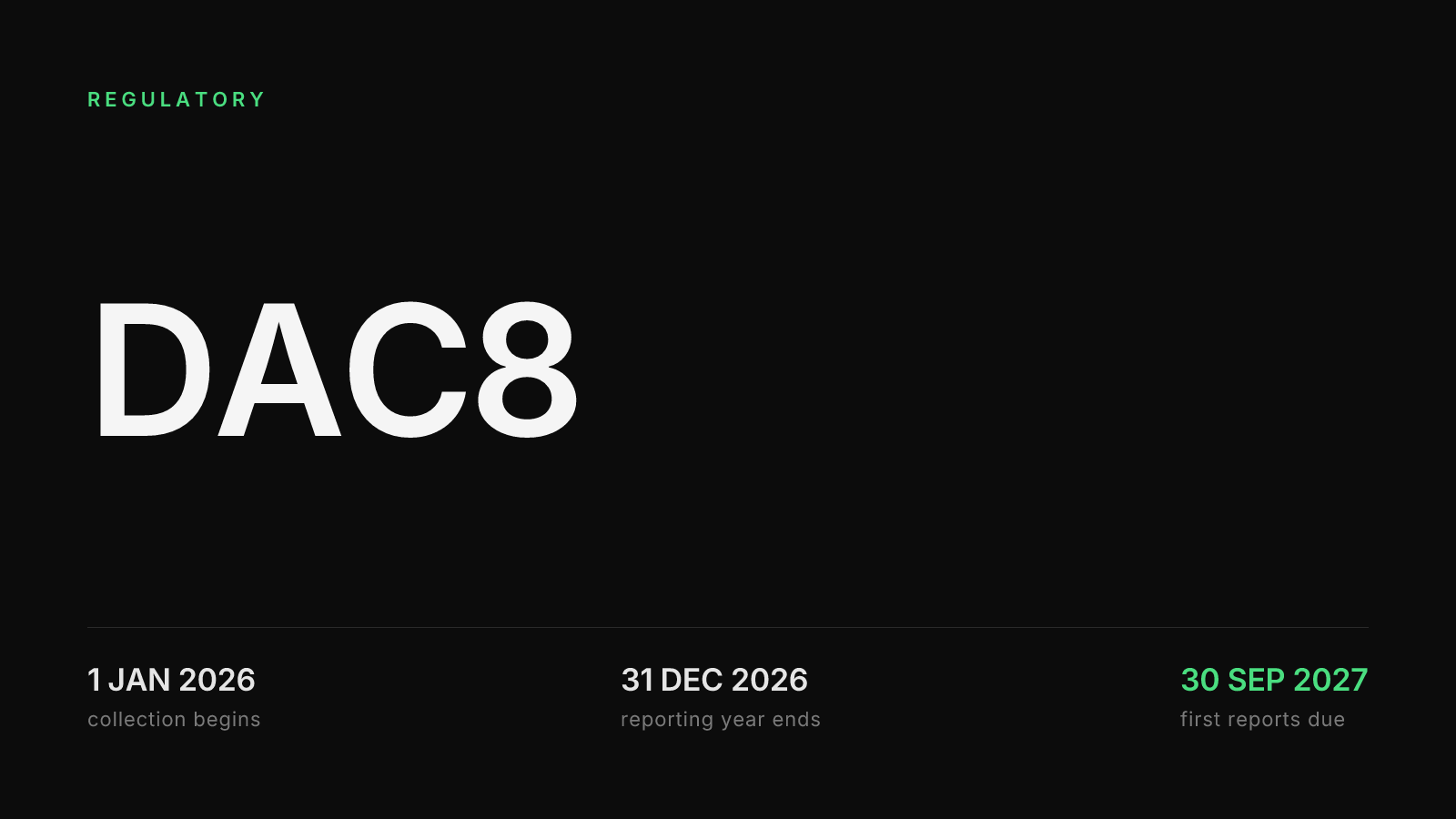
DAC8 — the eighth revision of the EU's Directive on Administrative Cooperation — entered into force on 1 January 2026. Crypto-asset service providers began collecting reportable data on every EU-resident user that day, and the first reports are due to tax authorities between 1 January and 30 September 2027.
Almost everything written about this was published around the start date and framed it as a future obligation. It isn't. Seven months of 2026 activity has already been recorded. The rest of the year will be too.
The part that deserves attention is not that reporting exists. It is the shape of what gets reported: aggregate gross amounts, not net gains. In 2027 tax authorities will receive a large number describing your total crypto flows and no information about what you paid for any of it. Reconciling that gap is your problem, and it is dramatically easier to solve in 2026 — while exchange records are still retrievable — than in 2027, when you are answering a query.
This is not tax advice. Rules vary by member state and personal circumstances; talk to an adviser in your jurisdiction before acting.
What DAC8 Actually Requires
The European Commission is specific about the mechanics. Providers must start "collecting data on reportable crypto-asset transactions of all EU-resident users, including residents of the Member State where you are established, from 1 January 2026."
What gets reported breaks into two categories:
| Category | What it contains |
|---|---|
| Identification | Details identifying both the service provider and the investor — including tax residence and tax identification number, established via user self-certification |
| Quantitative | Aggregate gross amount paid or received for acquisitions and disposals against fiat or other crypto-assets, plus aggregate fair market value for transfers |
Two structural details matter more than they first appear.
The reach is global, not European. The obligation attaches to any crypto-asset service provider with EU-resident users, regardless of where the provider itself is established. A non-EU exchange with EU customers is in scope. Providers operating in the EU without MiCA authorisation must complete a single registration in a member state.
It runs on rails that already exist. DAC8 is the EU implementation of the OECD's Crypto-Asset Reporting Framework. CARF has commitments from more than 60 jurisdictions, with first reporting in 2027 or 2028. Once a member state receives your data it is exchanged automatically with the others. This is the same architecture that made offshore bank accounts stop working as a concealment strategy, pointed at a new asset class.
The Gap Nobody Is Talking About
Here is the mechanical problem, and it is the reason this post exists.
DAC8 requires providers to report aggregate gross amounts. It does not require them to report what you paid to acquire the assets. No exchange can, reliably — because your acquisition often happened somewhere else.
Consider an ordinary year:
- You buy ETH on Exchange A in 2021.
- You move it to a self-custody wallet in 2023.
- You move it to Exchange B in 2026 and sell it.
Exchange B reports a disposal with a large gross value. It has no idea what you paid, because it never saw the purchase. From the tax authority's side, an unexplained inflow appears with no offsetting cost.
Your actual taxable gain might be modest. Your reported gross flow is not. The discrepancy is entirely legitimate and entirely your responsibility to evidence.
This pattern is not hypothetical — it is what happened in the US when brokers began issuing gross-proceeds forms without basis. The mismatch generated years of notices to taxpayers who had done nothing wrong but could not readily prove it.
Why July 2026 Is the Moment, Not 2027
The reporting deadline is September 2027, which makes this feel like next year's problem. It is not, for one specific reason: evidence decays.
- Exchanges delist pairs, change CSV export formats, and close accounts.
- Platforms fail. A collapsed exchange does not answer requests for 2021 trade history.
- Self-custody transfers leave an on-chain record of movement but no record of price at acquisition.
- Support teams that will answer a 2026 export request in 2026 are markedly less responsive about a five-year-old account in 2027.
Every month you wait, reconstructing basis gets harder and more expensive. The window where this is a tedious afternoon rather than a forensic project is open now.
What To Actually Do
Concrete, in priority order:
-
Export everything, from every venue, now. Full transaction history from every exchange you have ever used — including ones you no longer trade on and ones holding dust. Raw CSV, stored somewhere durable. This is the single highest-value hour you can spend.
-
Reconstruct cost basis per lot, not per asset. You need acquisition date and price for each tranche. Which accounting method applies — FIFO, weighted average, or something else — is set by your member state, and it changes the answer materially.
-
Label self-transfers explicitly. Wallet-to-wallet and exchange-to-wallet movements are not disposals, but they appear in the reported data as transfers with a fair market value attached. Unlabelled, they inflate apparent activity. Keep the transaction hashes.
-
Check your self-certification is correct. Providers must obtain tax residence and TIN from you. If an exchange holds a stale address or a missing TIN, your data may be reported to the wrong jurisdiction — or flagged. Worth ten minutes per account.
-
Reconcile 2026 before December. Run your numbers against exported records while the year is still live and corrections are cheap.
What This Does Not Change
Two clarifications, because both are widely misread.
DAC8 is a reporting rule, not a new tax. It does not create a liability that did not exist. Crypto gains were taxable in EU member states before 2026. What changes is visibility.
It is not meaningfully retroactive. The obligations apply to transactions from 1 January 2026 onward. But this is narrower comfort than it sounds: pre-2026 transactions remain tax-relevant under existing national law, authorities can still request older records through normal channels, and — as the example above shows — a 2021 purchase is exactly what determines the tax on a 2026 disposal. The reporting starts in 2026. The arithmetic reaches back much further.
The Uncomfortable Read
For most people holding crypto through regulated venues and declaring it properly, DAC8 changes very little beyond confirming what was already filed.
For everyone else, the useful framing is this: the period in which crypto tax positions were, in practice, self-reported and rarely checked ended on 1 January 2026. Not on the day the first reports arrive — on the day the recording started. The reports in 2027 are the visible part of a process that has been running quietly for seven months.
If your 2026 position needs work, it is much cheaper to fix it while the year is still open than to explain it after the data has already been exchanged.
Related Tools
Two projects of mine cover the practical side of this:
- Tax Reclaim EU — reclaiming withholding tax overpaid on cross-border dividends. Different mechanism from crypto reporting, same underlying reality: cross-border tax positions that go unclaimed because reconstructing the paperwork is tedious.
- Taxxy — tax tooling for people whose income, residence and assets do not all sit in one jurisdiction, which is most of the audience DAC8 affects.
If the cost-basis reconstruction described above is the thing standing between you and a clean 2026 filing, that is precisely the problem both are built around.
Sources: European Commission — DAC8 · OECD Crypto-Asset Reporting Framework overview · DAC8 and CARF reporting challenges for platforms — RSM