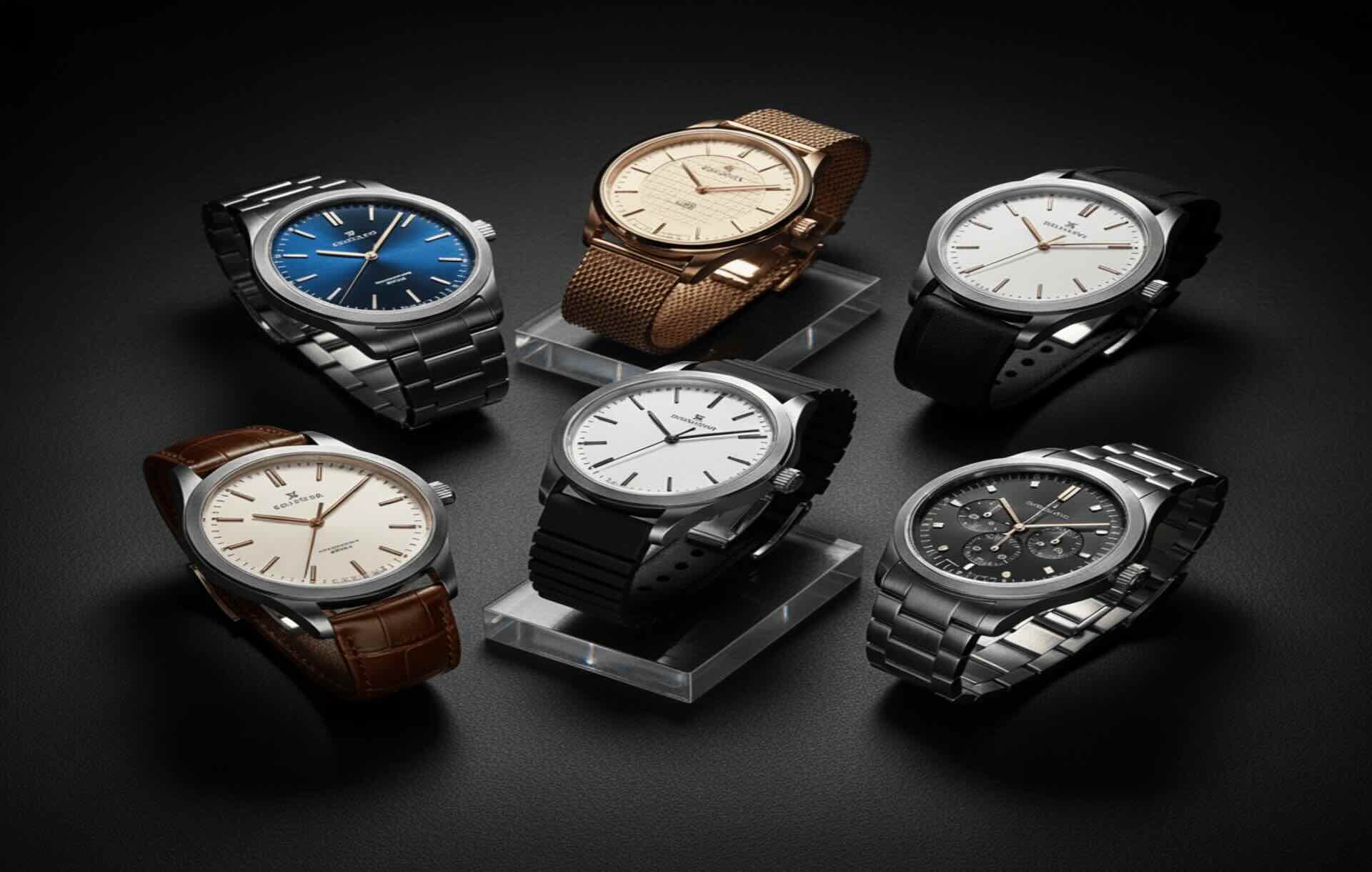
The Secondhand Market Is No Longer an Afterthought
Spend ten minutes on Vestiaire Collective, Chrono24, or the recently relaunched StockX Luxury division and something becomes immediately clear: the pre-owned luxury market has undergone a structural transformation. The dim-lit pawnshop model — where you took a watch in with mild embarrassment and left with a fraction of its retail value — has been replaced by a sophisticated, transparent, technology-mediated ecosystem with institutional backing, global liquidity, and returns that rival traditional asset classes.
In 2020, the global luxury resale market was worth approximately $36 billion. The current consensus forecast, compiled from Bain, McKinsey, and Kering's own strategic planning documents, puts it at $115 billion by 2027. For context, the entire primary luxury goods market — the new-goods tier — is estimated at around $380 billion. Pre-owned is not a footnote. It is roughly 30 % of the total luxury economy and growing at three times the rate of the primary market.
This is not merely a story about thrift. It is a story about technology, cultural shift, and the emergence of an entirely new investment category.
What Changed: Three Forces Converging at Once
The Authentication Problem Solved
For decades, the used luxury market was held back by one structural constraint: trust. The buyer could not verify the seller's claims. Counterfeiting — particularly in watches, handbags, and sneakers — was sophisticated enough to deceive everyone except specialist experts. The friction of verifying authenticity made transactions expensive, slow, and inaccessible to most buyers.
Three technological developments have largely dissolved this barrier.
Computer vision authentication — where deep learning models trained on millions of verified and counterfeit items analyse photographs across hundreds of micro-features — now operates at accuracy rates that match or exceed trained human experts for the most commonly traded categories. Entrupy, Legitcheck, and the in-house systems operated by major platforms can authenticate a Hermès Birkin from a 12-image submission in under four minutes, with a published false-negative rate below 0.3 %. The equivalent human expert review took 24–72 hours and cost $150–400.
Physical-digital linking via microscopic identifiers is the second layer. Companies like Certilogo (acquired by Farfetch in 2023) and Eon embed cryptographically unique identifiers — ultrafine chemical taggants, laser-etched nano-codes, or RF-enabled chips — directly into materials during manufacturing. The tag cannot be transferred to a counterfeit without detection. Scan it, and you retrieve the item's full history: factory, date, original retailer, and every subsequent authenticated resale transaction.
Blockchain immutability completes the chain of custody. Once a luxury item is registered on a provenance ledger — LVMH's Aura Blockchain Consortium now covers over 60 brands and has issued more than 40 million digital certificates — its history cannot be retrospectively altered. A watch listed on a resale platform can carry a QR code that resolves to an on-chain ownership history stretching back to manufacture. Buyers are paying a premium for this verifiability, and the data shows it: items with verified blockchain provenance command a 12–18 % price premium on Chrono24 versus equivalent items without it.
A Generational Pivot in Attitudes to Ownership
Millennials and Gen Z do not have the same cultural inhibitions about pre-owned luxury that characterised their parents. Multiple surveys — including Bain's annual Global Luxury Study and the Deloitte Millennial Survey — show that 72 % of luxury consumers under 35 have purchased or are open to purchasing pre-owned goods as their first entry into a luxury brand. For this cohort, circularity is not a compromise: it is a quality signal.
The framing has also shifted dramatically. Buying a pre-owned Patek Philippe is no longer described as "buying used." The language is now "acquiring a vintage investment-grade timepiece." The same Birkin that sold for €10,000 in 2018 and resold for €14,000 in 2021 and €19,000 in 2024 is not secondhand — it is an asset with a documented appreciation curve. The shift in language matters because language shapes markets: it determines who participates and how they value what they buy.
The sustainability argument reinforces this. The carbon footprint of a pre-owned luxury item — extending the useful life of an already manufactured product — is a fraction of producing a new equivalent. For consumers who weight environmental impact in purchasing decisions, pre-owned is the premium choice.
Institutional Capital Entering the Space
Kering acquired a 5 % stake in Vestiaire Collective in 2021 and increased it to 11 % in 2024. LVMH has its own resale certification program operating across Louis Vuitton and Dior. Richemont (which owns Cartier, IWC, Jaeger-LeCoultre, and Van Cleef & Arpels) operates the Watchfinder Group as a fully integrated pre-owned division, and Watchfinder's revenues grew 41 % year-on-year in 2025. Historically resistant luxury conglomerates — whose reflex was to fight the pre-owned market as brand-diluting — have concluded that they would rather own the ecosystem than cede it to independent platforms.
This institutional participation has several downstream effects. It increases trust. It brings professional inventory management and quality standards. And crucially for investors, it signals that pre-owned luxury is now a permanent, structurally supported feature of the luxury economy rather than a cyclical phenomenon that might reverse in the next bull market.
The Investment Logic: What Actually Appreciates
Not all pre-owned luxury performs equally as an investment. Understanding the mechanics requires drawing some important distinctions.
Watches: The Hardest Asset in Soft Luxury
High-end mechanical watches remain the most liquid and data-rich sub-category in luxury resale. The Watch Charts index — which tracks the secondary market prices of the 100 most-traded references — has compounded at 8.3 % per annum over the past decade, though with significant volatility: the 2021–22 speculative bubble (in which certain Rolex and Patek references briefly doubled) was followed by a 30–40 % correction before the market stabilised and resumed its longer-term appreciation trend.
The references that have demonstrated the most consistent real returns are Rolex sports models (Submariner, GMT-Master II, Daytona), Patek Philippe complications (Nautilus, Aquanaut, Annual Calendar), and select Audemars Piguet Royal Oak references. These share three characteristics: limited production relative to demand, secondary market infrastructure that provides genuine liquidity, and cultural cachet that has proved durable across economic cycles.
The investment thesis is not simply "luxury goods go up." It is more specific: manufactured scarcity by trusted brands, with deep secondary market infrastructure and documented price history, creates risk-adjusted returns that correlate weakly with equity and bond markets. For a portfolio seeking uncorrelated returns, that matters.
| Category | 10-Year CAGR | Liquidity | Correlation to S&P 500 | Key Risks |
|---|---|---|---|---|
| Rolex Sports Models | 9.1 % | High | Low | Speculative bubbles, counterfeits |
| Patek Philippe Complications | 11.2 % | Medium | Very Low | Illiquid at peak prices |
| Hermès Birkin/Kelly | 13.7 % | Medium | Low | Condition sensitivity, fakes |
| Supreme/Off-White Streetwear | 6.2 % | High | Medium | Trend-dependent, no intrinsic value |
| Fine Jewellery (signed) | 7.8 % | Low | Very Low | Highly condition and market-dependent |
Source: Watch Charts, Bain & Company, Deloitte Luxury Research Unit. CAGR calculated to end of 2025.
Handbags: The Hermès Paradox
The Hermès Birkin and Kelly bags have outperformed almost every traditional asset class over the past two decades on a total return basis. Knight Frank's Luxury Investment Index places signed Hermès pieces among the top-five performing collectible categories, behind only fine wine and rare whisky in the 2024 survey.
The investment rationale is unusual. Hermès deliberately constrains supply not through limited editions but through manufacturing discipline: each bag takes 18–25 hours of skilled artisan work, and the house has consistently refused to industrialise production. Combined with waiting lists that can exceed two years in key markets and a price increase strategy (Hermès raises prices by 5–10 % annually) that has consistently outpaced inflation, the secondary market for entry-condition Hermès pieces has demonstrated extraordinary resilience.
The risk is equally real: condition is paramount. A Birkin in pristine condition with its original box, dust bag, and receipt commands 30–50 % more than the same reference with moderate wear. Storage, handling, and provenance documentation are non-trivial operational requirements that differentiate this category from financial instruments.
Sneakers and Streetwear: Higher Risk, Different Demographics
The sneaker resale market peaked in 2021 and has since normalised, with overproduced Nike/Jordan collaboration drops no longer delivering automatic returns. What remains is a smaller, more sophisticated market centred on genuine scarcity (Nike Air Yeezy 1 and 2, original Air Jordan 1 colourways, New Balance 990 made-in-USA models) and proven cultural significance.
The streetwear category — Supreme box logos, Dior x Jordan collaborations, Palace full-zip tracksuit sets — has similarly bifurcated into pieces with long-term cultural resonance and pieces that were speculative in the moment and have since depreciated. Navigating this space requires trend literacy that goes beyond financial analysis.
The Platforms: Where the Market Lives
The pre-owned luxury ecosystem has consolidated around a handful of dominant platforms, each with distinct positioning.
Chrono24 remains the dominant marketplace for pre-owned watches globally, with 550,000+ listings and a transaction volume exceeding €3.5 billion in 2025. Its buyer protection, escrow system, and integration with Aura blockchain certificates have made it the default reference point for watch pricing globally.
Vestiaire Collective handles fashion, handbags, and accessories with a hybrid model: seller-listed items authenticated before delivery. The platform introduced Direct Shipping in 2024 — bypassing warehouse authentication for repeat sellers with strong track records — substantially reducing friction while maintaining quality signals through seller rating systems.
The RealReal operates a consignment model for the North American market, providing full authentication and handling logistics. Its integration with AI-assisted pricing — which analyses comparable sold listings and current demand to recommend consignment prices — has improved seller conversion significantly.
StockX has evolved from its sneaker roots into a broader luxury marketplace, applying its IPO-model pricing (items list at ask, buyers bid, transactions execute at overlap) to watches, handbags, and trading cards. The model provides price discovery transparency unavailable on traditional consignment platforms.
Watchfinder (Richemont) and Certified Pre-Owned by manufacturers represent the brand-direct channel: items authenticated and reconditioned by the original manufacturer and resold with manufacturer warranty. Rolex's Certified Pre-Owned programme, launched globally in 2022, charges a premium over third-party platforms but delivers a warranty-backed product that appeals to first-time pre-owned buyers hesitant about independent authentication.
How to Participate: A Practical Framework
The pre-owned luxury market is accessible at multiple levels of capital commitment and operational involvement.
Direct collecting — buying specific watches, bags, or pieces with documented price history — requires capital starting around €2,000–5,000 for entry-level investment-grade references (a steel Rolex Oyster Perpetual, a pre-owned Louis Vuitton Neverfull MM in excellent condition) and carries the operational overhead of storage, insurance, and eventual sale. The upside is full ownership of the asset and the enjoyment of using it; the downside is illiquidity and the expertise required to buy and sell well.
Collectible asset funds offer institutional exposure without operational burden. Funds like Rally, Otis, and Collectable offer fractional ownership of authenticated luxury assets, allowing investors to buy shares in specific pieces from as little as $50. Liquidity is limited and fees matter, but for investors seeking exposure without the complexity of direct ownership, fractional platforms represent a genuine option.
Luxury resale platform equity provides indirect exposure through publicly listed or pre-IPO positions. The RealReal (REAL) is listed on NASDAQ; Vestiaire Collective's IPO timeline has been discussed repeatedly since 2023 and is anticipated before end-2027. Watchfinder's financial performance is reflected in Richemont's results. For investors who prefer equity over collectibles, this is a cleaner instrument.
Brand equity via listed luxury conglomerates — LVMH, Kering, Richemont, Hermès International — remains the most liquid and diversified exposure to the luxury economy, including its pre-owned growth tailwind. These equities trade at significant premiums to broader markets, reflecting the long-run compounding properties of luxury brand economics.
The Risks a Bullish Story Can Obscure
No asset class exists without risk, and pre-owned luxury carries specific vulnerabilities worth understanding clearly.
Taste and cultural risk is the most fundamental: the value of a collectible depends entirely on continued demand from future buyers. Hermès has managed this for over 180 years; Supreme has managed it for under 30. The correlation between brand longevity and investment safety is high, but it cannot be guaranteed.
Condition degradation is an ongoing concern. A watch that is worn, scratched, and unpolished (some collectors prefer unpolished cases as a sign of originality; others devalue them) has a different market value than one preserved in a box. The operational requirements of preserving investment-grade luxury are non-trivial.
Market liquidity cycles can be severe. The 2021–22 watch bubble demonstrated that pre-owned luxury, like any asset market, can experience momentum-driven speculation that subsequently corrects sharply. The long-run appreciation trend is real, but investors who bought at peak 2022 prices experienced mark-to-market losses of 30–40 % before recovery.
Regulatory evolution around luxury resale — particularly relating to sustainability claims, data privacy in provenance records, and potential transaction taxes — is ongoing and uncertain in several major markets.
The Bigger Picture: Circularity as the Future of Luxury
What is happening in pre-owned luxury is part of a broader structural shift in how affluent consumers relate to physical goods. Ownership is being disaggregated: renting, borrowing, fractional ownership, and resale are all growing at the expense of traditional one-time-purchase-and-retain behaviour.
For luxury brands, this creates both a threat and an opportunity. The threat is disintermediation: if consumers buy pre-owned, the brand does not collect the primary retail margin. The opportunity — and the reason Kering, LVMH, and Richemont are all investing heavily — is that a robust secondary market validates the durability and collectibility of primary purchases. The best marketing for a new Rolex Submariner is the fact that you can resell it for more than you paid.
The brands that lean into this dynamic — that invest in authentication infrastructure, build relationships with resale platforms, and create the conditions for secondary market liquidity — will find their primary pricing power reinforced. The brands that resist it will find the secondary market happening anyway, less orderly, less brand-enhancing, and outside their control.
The Beautiful Game Beneath the Numbers
There is a version of luxury investment that is purely financial: spreadsheets, price indices, liquidity ratios, diversification benefits. That version is real and worth understanding.
But it misses something.
The pre-owned watch handed down from a grandfather. The vintage Hermès scarf purchased in a Paris marché aux puces in 1994 and worn still. The Levi's 501 from 1982, the ones with the unwashed indigo and the leather patch and the construction that Levi Strauss abandoned in the 1990s in the interests of margin — these objects carry something that no newly manufactured product can carry, regardless of its price tag. They carry time.
That is what pre-owned luxury sells, and why no balance sheet can fully capture its appeal. The technology that now authenticates, traces, and prices these objects with extraordinary precision is making them more accessible, more trustworthy, and more valuable as financial instruments.
But the reason they are worth preserving — and the reason thoughtful collectors have always understood their value even before the algorithms confirmed it — is older than any market and cannot be tokenised.
Invest wisely. Wear what you love.
Conclusion
The pre-owned luxury market in 2026 is defined by a convergence that rarely happens cleanly: cultural shift, technological enablement, and institutional validation arriving at the same time. AI authentication, blockchain provenance, and the generational normalisation of secondhand luxury have together created a market that is larger, more transparent, and more accessible than at any point in history.
For investors, the case rests on three pillars: uncorrelated returns (luxury asset prices have low historical correlation with equity and bond markets), genuine scarcity in the most desirable categories, and structural demand growth driven by the world's expanding affluent class. For consumers, the case is simpler: extraordinary objects, authenticated and traceable, available at prices that reflect the beauty of circular ownership rather than the premium of novelty.
The luxury resale revolution is not coming. It is already here, and it is just getting started.