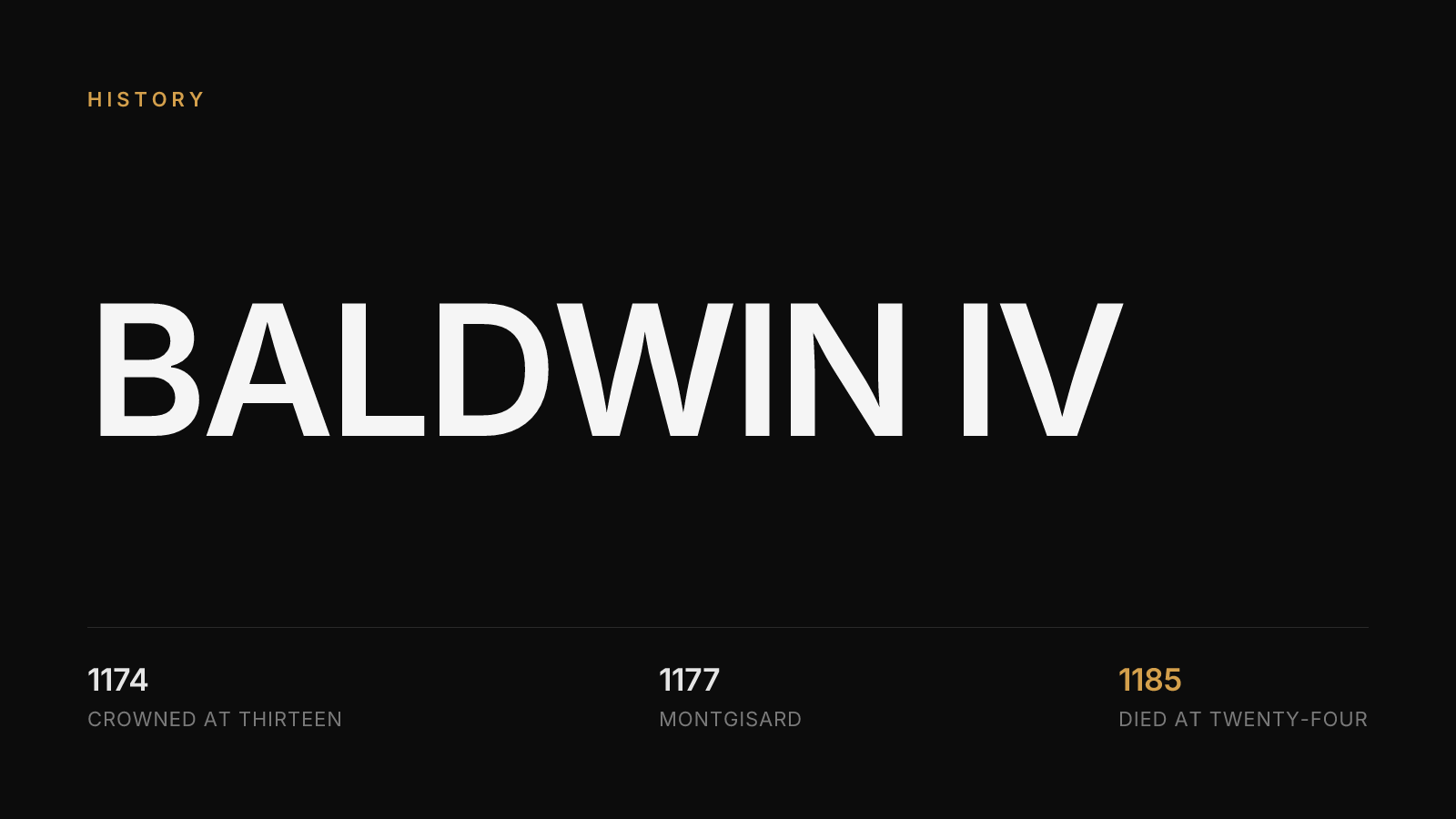
The Mask Is a Prop
Ask almost anyone what they know about Baldwin IV of Jerusalem and you get an image before you get a fact: a silver mask, a voice from behind it, a young man on a throne in a darkened room.
That image comes from Kingdom of Heaven, released in 2005. The film is good at what it does. The mask is not history. No contemporary source puts one on him.
This is worth more than a costume footnote, because the invention quietly changes the shape of the story. A masked king is a symbol — sealed off, remote, tragic in a way that asks nothing of him except endurance. The king in the record is doing something considerably harder. He is deteriorating visibly, in front of a court that is already calculating what happens when he dies, and he keeps turning up: at councils, on campaign, in the field, at the head of an army. He was crowned at thirteen. He was dead at twenty-three or twenty-four. In between, at sixteen, he defeated Saladin in open battle.
Then, within two years of his death, the kingdom he had spent his reign holding together came apart entirely.
That is the actual subject here. Not a tragic mask, but a political arrangement that depended on one dying teenager far more than anyone involved wanted to admit — and that could not survive losing him.
The Kingdom He Inherited
The Kingdom of Jerusalem that Baldwin took over in 1174 was roughly three generations old. It had been established by the First Crusade, and by the 1170s the founding generation was long gone. What remained was a Latin Christian state on a narrow coastal strip: a handful of cities, a network of castles, a permanently insufficient supply of fighting men, and a landholding nobility whose families had had decades to accumulate rivalries.
Two structural facts governed everything.
The first is that the kingdom had always survived on the divisions of its neighbours. It had never been strong enough to defeat a unified opponent, and it had never had to. Its security was a function of somebody else's fragmentation.
The second is that this was ending. Saladin had taken control of Egypt and was extending his authority into Syria, and the practical consequence was that the territory around the kingdom was consolidating under a single command for the first time in its existence. Nothing Baldwin did or failed to do altered that. The strategic position he inherited was deteriorating structurally, and would have been deteriorating under any king.
Which brings in the third thing, the one that made the reign so unstable: a kingdom in that position needed a king who could take the field. Not as ceremony — as the mechanism by which a fractious nobility was assembled into an army at all. Kingship here was physical. It required a body.
Baldwin's body was failing before he was crowned, and everyone knew it.
A Boy on a Contested Throne
The illness, and the word for it
The single best-known moment in Baldwin's life happened years before he became king, and we have it because his tutor was a first-rate historian.
William of Tyre was educating the boy when he noticed something during play. Baldwin and his companions were roughhousing, the way children do, hurting each other's arms — and Baldwin did not react. He did not appear to feel it. William's alarm was not at a bruise. It was that the boy was not registering injury at all.
That detail has survived because it is exactly the right detail — and because William is candid about not grasping it straight away. By his own account he first read the boy's indifference as endurance: a child being tough about a scrape, which is what it looks like. Only after he called Baldwin over and questioned him did he understand what he was actually seeing. The realisation was delayed. It was also correct.
What he did not do was hand us a diagnosis. This is the point where most retellings — including, in fairness, the subtitle of this article — go slightly further than the evidence goes. "Diagnosed at nine" implies a physician naming a disease. What actually survives is a description: a teacher observing that a child of about nine could not feel his own arm, followed by an account of a body that kept getting worse. Contemporary writers describe the progression of the illness. They do not describe it in the terms a modern clinician would use, and they are not making the claim we now read into them. More on that below, because it is the most consequential piece of imprecision in the whole story.
Regency, faction, and the problem of the next king
Baldwin's father died in 1174 and Baldwin was crowned at thirteen. From that day, the reign had two simultaneous subjects, and only one of them was the war.
The other was the succession — and it dominated. Not eventually; immediately. Every noble in the kingdom could see what everyone else could see: this king was ill, this king would not produce an heir, and this king would not live long. So the entire political class was doing two things at once, permanently. Serving the crown, and positioning for the day it became available.
Control of the machinery moved with that calculation. Early on it ran through Raymond III of Tripoli, who held the regency for the boy king. Later, factional weight shifted to Guy of Lusignan, a newcomer who had married Baldwin's sister and acquired, with that marriage, a claim on the throne.
This is the part the films flatten into a court intrigue subplot. It was not a subplot. It was the reign. A king in Baldwin's position had almost no ability to settle the question — he could not out-wait his rivals, because time was the one resource he did not have — and so he spent his reign managing a nobility that was in a slow, continuous argument about what to do when he stopped breathing.
That he kept it from breaking open while he lived is the most underrated fact about him. It is also, as we will see, the fact best confirmed by what happened when he stopped.
Montgisard, 25 November 1177
On 25 November 1177, Baldwin IV — sixteen years old, and by then visibly ill — met a much larger force under Saladin and beat it.
Montgisard is the defining military event of the reign, and it is firmly established. The date is fixed. The disparity in size is agreed on by sources writing from opposite sides. The outcome is not in dispute: Saladin's army was broken in the field.
What is not firmly established is any specific number. Medieval chroniclers on both sides give figures for Montgisard that cannot be reconciled with each other and were never intended as accounting. Round numbers in twelfth-century battle narratives are rhetorical instruments — they exist to convey scale, disgrace, or divine favour. Any modern retelling that gives you a precise ratio of forces at Montgisard is presenting a literary flourish as a headcount. The honest version is the one the sources actually support: Baldwin's army was much the smaller, and it won anyway.
What the battle did not change
Montgisard mattered. It punctured the assumption that Saladin's consolidation had already made him unbeatable in open battle, and it bought the kingdom years.
It did not change the arithmetic. Saladin could lose an army and raise another. Jerusalem could not. A single defeat at the wrong moment would cost the kingdom its entire field force, and there was no second one behind it. This is the asymmetry that makes the whole reign legible: Baldwin was not winning a war. He was refusing to lose it yet.
What Montgisard does tell us about Baldwin is the thing that survives all the source problems: he was there. A king who could not be relied on to appear in the field could not hold this nobility together, and Baldwin — with every possible excuse to delegate — appeared. The military value of the king's presence was, in the end, political.
The two years after
Baldwin died in 1185, aged twenty-three or twenty-four; his birth in 1161 is recorded, the precise date is not, and that is enough to leave the number unsettled.
He was succeeded by his nephew, Baldwin V, a child. The child died in 1186.
In 1187 the kingdom's army was destroyed at Hattin, and Jerusalem was lost. The king who led that army to Hattin was Guy of Lusignan — the same claimant whose position Baldwin had spent years trying to contain.
The temptation here is enormous, and worth resisting: to say that Baldwin would have prevented it. There is no evidence for that and the structural picture argues against it. Saladin's advantage was material and growing. What Baldwin's death removed was not a war-winning general. It was the one figure in the kingdom whose right to the throne nobody disputed — and with him gone, the argument the nobility had been having quietly for eleven years became the thing that decided who commanded the army.
He was holding a losing position. Then he stopped holding it, and it was lost in little more than two years.
What the Sources Actually Support
Almost everything in this article traces back, directly or at one remove, to a single writer. That is worth being blunt about.
William of Tyre is the central source. He was Baldwin's tutor, he knew him personally, he held high office in the kingdom, and his chronicle is the closest thing we have to an eyewitness account of the reign. This is unusually good evidence by twelfth-century standards.
It is not neutral evidence. William was a participant, writing about a court he served in, with his own commitments and his own opinions of the men competing around the throne. And his narrative does not run all the way to Baldwin's death — a fair amount of what is popularly "known" about the end of the reign comes not from William but from later continuations and translations of his work.
That distinction does real damage when it is ignored. Those continuations were written after Jerusalem had fallen, by people who knew how the story ended and had strong views about whose fault it was. They are markedly hostile to Guy of Lusignan. The clean moral architecture that every popular retelling of this period still uses — the noble dying king, the grasping successor who threw it all away — is not a neutral finding that emerged from the evidence. It is a twelfth-century argument, made by people with a stake in it, that we have been repeating ever since. Arabic accounts written on Saladin's side are genuinely valuable as a cross-check, and they were also written for patrons who expected a particular shape of story.
The diagnosis is an inference, not a record. This is the claim most worth handling carefully, because it is in the man's nickname and in the title of this article.
What the sources give us is a description: loss of sensation in a limb in childhood, and a progressive, disfiguring, ultimately fatal illness over roughly fifteen years. What they do not give us is a modern clinical diagnosis, because that category did not exist for them. Medieval "leprosy" was a broad and elastic label that covered a range of visible skin diseases with wildly different causes. When a twelfth-century writer applies it, he is not identifying the organism we now call Mycobacterium leprae.
The retrospective identification of Hansen's disease is a reasonable inference — the early loss of sensation is characteristic, and the reported progression is consistent — and it is very widely accepted. It is still an inference, drawn from descriptions rather than from physical evidence, and it should be held slightly more loosely than the confident phrase "the Leper King" suggests.
The firm ground, then, is narrow but solid: born 1161; king from 1174, crowned at thirteen; a serious progressive illness noticed in childhood by a tutor who became the reign's chronicler; a decisive victory over a larger force at Montgisard on 25 November 1177 at the age of sixteen; a reign dominated by the succession question and by factional control passing between Raymond III of Tripoli and Guy of Lusignan; death in 1185; a child successor who died in 1186; catastrophe in 1187.
The soft ground is most of the rest: the numbers at Montgisard, the specific clinical course of the illness, the private character of the man, and above all the moral framing — the good king and the bad successor — which we inherited pre-packaged from writers who were losing an argument about who lost Jerusalem.
Strip the mask off and what remains is not less interesting. It is a teenager who was told early that his body would kill him, who took a crown that required him to ride out in person, and who rode out anyway, repeatedly, for eleven years, into a strategic position that was worsening every year regardless of what he did. He did not save the kingdom. Nobody could have. He postponed it, and the moment he was gone the postponement ended.
The mask makes that smaller. What he was actually doing needed a face.